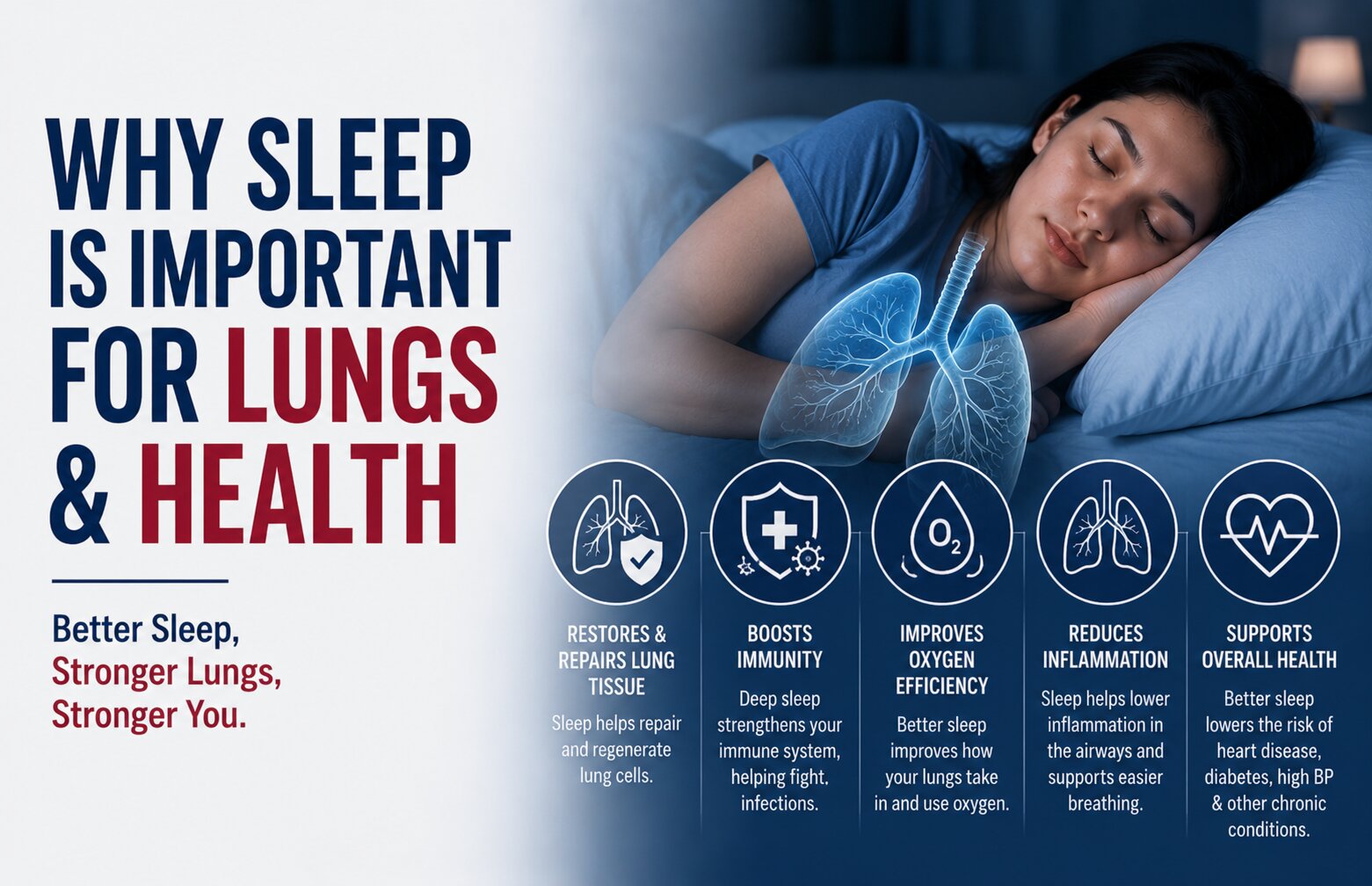
During sleep, the body carries out maintenance work that simply cannot happen effectively while you are awake. Growth hormone is released, driving tissue repair. The immune system consolidates its defences. The brain clears metabolic waste through the glymphatic system. Blood pressure drops to its lowest point of the day, giving the cardiovascular system a period of reduced workload. Inflammatory markers reset.
This overnight work is not optional. Miss it occasionally and the body compensates. Miss it chronically and the deficits begin to accumulate in measurable, clinically significant ways.
Sleep and Lung Health A Connection Most Patients Don't Expect
When patients think about what affects their lungs, they think about smoking, pollution, infections, and allergies. Sleep rarely comes to mind. But the relationship between sleep quality and respiratory health is direct and significant.
Overnight Oxygen and the Breathing Cycle
Normal breathing during sleep is not identical to breathing while awake. As the body relaxes and transitions through sleep stages, breathing slows and becomes more regular. This is expected and normal. But in patients with obstructive sleep apnea, the airway partially or fully collapses repeatedly through the night, causing breathing to stop sometimes for ten seconds, sometimes for a minute or more before the brain triggers a brief arousal to restore airflow.
Each of these events causes a drop in blood oxygen levels. Repeated hundreds of times per night, this pattern called nocturnal hypoxia places sustained physiological stress on virtually every organ in the body, including the lungs themselves.
Sleep and Asthma
For patients with asthma, sleep quality is not a minor consideration, it is a clinical one. Airway resistance follows a circadian pattern, peaking in the early morning hours between roughly 4 and 6am. This is why asthma attacks and nocturnal coughing cluster at that time. Poor sleep, by disrupting the circadian system, can destabilise this pattern and worsen airway inflammation. Patients with asthma who also have untreated sleep apnea consistently show poorer disease control than those without.
Sleep and COPD
Patients with chronic obstructive pulmonary disease are particularly vulnerable to the effects of disrupted sleep. Oxygen levels in COPD patients naturally fall during REM sleep even in the absence of sleep apnea, because breathing becomes shallower and less efficient during this stage. When sleep apnea is also present and the two conditions co-occur more often than most patients realise the overnight oxygen drops become more severe and more prolonged. This combination, sometimes called overlap syndrome, is associated with significantly worse outcomes than either condition alone.
Sleep and Cardiovascular Health
The heart does not get a holiday during sleep. But it does get relief. Blood pressure drops during healthy sleep, particularly during deep NREM stages. This nightly dip is protective. It gives blood vessels time to recover from the pressures of the waking day.
Chronic sleep deprivation removes that relief. Blood pressure remains elevated for longer, arterial walls are exposed to more sustained stress, and the risk of hypertension, heart attack, and stroke rises measurably. Research has consistently shown that adults sleeping fewer than six hours per night carry a significantly higher cardiovascular risk than those sleeping seven to eight.
Obstructive sleep apnea adds another layer to this. Each apnea event triggers a brief surge in blood pressure and heart rate as the brain forces an arousal to restore breathing. In a patient experiencing 30 to 40 events per hour across seven or eight hours of sleep, those surges add up. Over time, this is one of the primary mechanisms through which untreated sleep apnea contributes to hypertension, atrial fibrillation, and heart failure.
Sleep and the Immune System
The immune system operates on a schedule, and that schedule is partly circadian. Certain immune responses, the production of cytokines, the activity of T cells and natural killer cells are most active during specific sleep stages. Disrupting those stages disrupts immune function.
Patients who consistently sleep fewer than seven hours are measurably more susceptible to viral respiratory infections. One well-known study found that people sleeping six hours or fewer were more than four times more likely to develop a cold after controlled exposure to a rhinovirus than those sleeping seven or more hours. For patients already managing lung conditions, this matters considerably. A respiratory infection that a well-rested immune system handles in a week can set a COPD or asthma patient back significantly.
Sleep and Metabolism
Sleep and metabolic health are deeply intertwined. Two hormones that regulate appetite ghrelin and leptin are directly affected by sleep duration. Short sleep raises ghrelin (the hunger signal) and suppresses leptin (the fullness signal), creating a hormonal environment that promotes overeating and weight gain. Insulin sensitivity also decreases with sleep deprivation, raising the risk of type 2 diabetes over time.
This matters for respiratory health in a practical way. Excess weight, particularly around the neck and upper airway, is one of the primary risk factors for obstructive sleep apnea. A cycle can develop: poor sleep drives weight gain, weight gain worsens sleep apnea, and worsening sleep apnea further degrades sleep quality. Without addressing the sleep disorder directly, breaking that cycle becomes very difficult.
Sleep and Mental Health The Organ Nobody Talks About
The brain is as much an organ as the lungs or the heart, and it is profoundly affected by sleep deprivation. Mood regulation, emotional resilience, cognitive performance, and memory consolidation all depend on adequate, well-structured sleep. Chronic sleep loss is strongly associated with depression, anxiety, and increased psychological stress conditions that in turn worsen sleep quality, creating a cycle that can be difficult to break without clinical support.
In patients managing chronic illness including respiratory disease mental health is a significant determinant of treatment adherence and overall outcomes. Sleep that consistently fails to restore mental and emotional function compounds every other aspect of medical management.
When Sleep Problems Become a Medical Priority
Not every night of poor sleep requires a clinical evaluation. But certain patterns do.
Speak to a doctor if you are experiencing:
- Persistent fatigue that does not resolve with rest
- Loud or regular snoring, especially if a partner notices pausing or gasping
- Waking unrefreshed regardless of how long you sleep
- Excessive daytime sleepiness affecting work or daily activities
- Morning headaches on a regular basis
- Worsening control of an existing lung or cardiovascular condition without a clear cause
These symptoms may point to obstructive sleep apnea or another sleep disorder both of which are treatable once properly diagnosed. A sleep study or home sleep test can determine what is actually happening during the night and guide appropriate management.
Key Takeaways
- Sleep is an active biological process during which the body repairs tissue, regulates immune function, consolidates cardiovascular recovery, and resets hormonal systems
- Poor sleep directly worsens lung health particularly in patients with asthma, COPD, and sleep-related breathing disorders
- Nocturnal hypoxia from sleep apnea places sustained stress on the heart, lungs, and vascular system
- Chronic sleep deprivation is independently associated with hypertension, cardiovascular disease, metabolic syndrome, and immune impairment
- The overlap of sleep apnea with respiratory conditions like COPD significantly worsens outcomes for both
- Sleep quality matters as much as duration fragmented sleep from an undiagnosed disorder is just as damaging as too few hours
- Persistent unexplained fatigue, snoring, or worsening disease control warrants a sleep medicine evaluation