Should your physician advise you to undergo a sleep study, then having some doubts and questions in your head is quite understandable. For many people, the notion of spending the night in a strange bed and being watched the whole time causes discomfort. Questions arise: Am I going to be able to fall asleep? Is it painful? Am I going to be pinned to my bed by a bunch of wires?
The procedure has a fancy medical term – polysomnography, but despite its complicated sound, it is not something you have to worry about. It is absolutely painless and easy-to-undergo examination.
Getting to know what a sleep study is like will remove all fears and help you come to the clinic feeling relaxed.
Here we are going to reveal the whole process of the procedure, starting from the preparation stage and finishing with awakening the next morning.
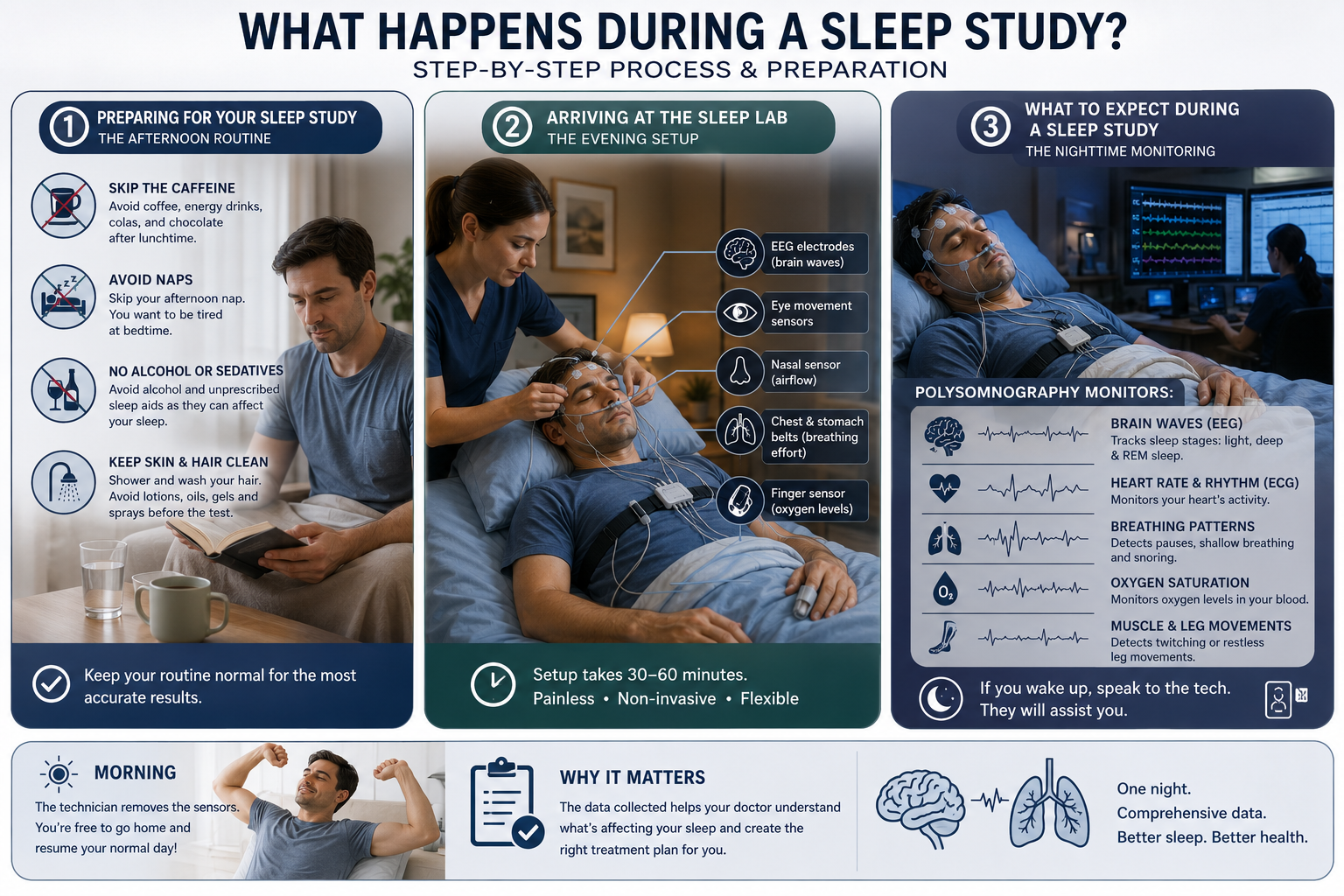
1. Preparing for Your Sleep Study: The Afternoon Routine
A successful evaluation begins long before you actually step foot inside the sleep lab. Proper sleep study preparation ensures that the data collected by the medical team is an accurate reflection of your typical, everyday sleep patterns.
On the day of your scheduled test, your main goal is to keep things as completely normal as possible, with just a few minor adjustments:
- Skip the Caffeine: Avoid coffee, energy drinks, colas, and chocolate after lunchtime. Caffeine can artificially alter your sleep architecture and make it difficult to drift off.
- Avoid Naps: Even if you feel incredibly exhausted during the day, skip your afternoon nap. You want to ensure you are sufficiently tired when it is time to turn off the lights.
- No Alcohol or Sedatives: Avoid alcoholic beverages or any unprescribed sleeping aids, as these substances can artificially suppress certain stages of sleep or worsen breathing issues like sleep apnea.
- Keep Your Skin and Hair Clean: Shower and wash your hair thoroughly. Avoid applying heavy body lotions, skin oils, hair gels, or sprays afterward. The medical sensors adhere best to clean, dry skin and hair.
2. Arriving at the Sleep Lab: The Evening Setup
Upon your arrival at the sleep center in the early evening hours, most likely between 8:00 and 9:00 PM, you will probably be surprised by the modern design of the facilities, which resemble hotel rooms rather than hospital environments. Your sleeping area will include a standard bed, a bedside table with reading lights, as well as a personal TV set.
After settling down, you will put on your pajamas, and after that a specially trained sleep technician will come to talk to you and attach the sleep recording devices. It will take approximately half an hour to one hour for the technician to do this.
For this purpose, the technician will apply a special medical water-soluble paste to your forehead and chin to attach small flat metal electrodes to these areas of your body. In addition, the technician will also fix some flexible elastic bands around your chest and stomach, a nasal sensor to monitor the air flow, as well as an oximeter on your finger.
It may seem like a lot of equipment, but it doesn’t hurt at all. The wires are collected in one very flexible unit that is plugged into a small box located close to your bed, giving you the freedom to move around as you want.
3. What to Expect During a Sleep Study: The Nighttime Monitoring
After connection, you can read a book or watch a little bit of TV up to your bed time. Once you are ready for bed, the technician will do an equipment calibration. They will ask you through an intercom in the room to do some simple tasks like blink your eyes, move your jaw, and move your feet. All this is done to ensure that all sensors work effectively.
Once the equipment has been calibrated, the lights will go off.
Throughout the night, the technician stays awake in a separate control room, continuously watching the data stream across their computer screens. Polysomnography monitors an extensive array of vital bodily functions:
- Brain Waves (EEG): Tracks your exact sleep stages, measuring how much time you spend in light sleep, deep restorative sleep, and REM (dreaming) sleep.
- Heart Rate & Rhythm (ECG): Monitors how your cardiovascular system behaves during rest.
- Breathing Patterns: Records any pauses in breathing, shallow breaths, or heavy snoring.
- Oxygen Saturation: Keeps tabs on the oxygen levels in your blood, which can drop significantly if your airway becomes blocked.
- Muscle and Leg Movements: Identifies subconscious twitching or restless leg movements that might be breaking up your sleep cycles.
If you happen to wake up in the middle of the night and need to use the restroom, there is absolutely no need to panic. You simply speak aloud into the room; the technician will hear you through the intercom, come in, and quickly disconnect the main cable bundle so you can get up safely.
4. Waking Up: The Morning Routine
The process ends early in the morning on the following day, typically around 6:00 AM. At this time, the technician will wake you up and enter the room to take off all the electrodes. Adhesive paste comes off easily using warm water and shampoo.
After removal of electrodes, you have completed the entire procedure. Most sleep centers have private shower rooms where you may clean yourself, put away things and then leave for work or other activities of the day.
However, the massive amount of data collected during your examination cannot be made available right away. A technician has to manually score the data and interpret the findings by a specialist. Typically within one or two weeks, you will need to visit the center again for interpretation of findings and treatment plans, if necessary.
Finding Expert Care: Sleep Studies in Dubai
If you are experiencing severe daytime fatigue, chronic morning headaches, or loud snoring that disrupts your household, it is essential to have your sleep evaluated by an expert who understands the deep complexities of respiratory medicine.
For patients looking to navigate their sleep issues, Prof. Dr. Syed Arshad Husain provides comprehensive, world-class respiratory care. Serving as the Lead Consultant Pulmonologist at Al Zahra Hospital Dubai, Dr. Husain brings over 30 years of extensive clinical experience from the UK's National Health Service (NHS) alongside more than 18 years of specialized expertise in treating complex respiratory and sleep-related breathing disorders.
Dr. Husain’s dedicated clinic specializes in the precise evaluation and management of sleep apnea syndrome and related breathing conditions. Choosing a physician with deep interventional experience ensures that your diagnostic journey is accurate and highly personalized. To explore his helpful medical resources, learn more about his approach to sleep care, or easily schedule an appointment, visit his website at drsyedarshadhusainpulmonologist.com.