Let's answer the main topic right out of the gate. The relationship between weight loss and sleep apnea is one of cause and effect, but it works in both directions.
When you carry excess weight, your body doesn't just store fat on your belly or your thighs. It also stores fat in the tissues surrounding your neck and throat. When you lie down to sleep and your muscles relax, the physical weight of that extra fatty tissue presses down on your windpipe. This leads directly to the collapse of the airway.
Conversely, when you lose weight, that fat padding around the throat shrinks. The physical pressure on your windpipe is lifted. For a massive percentage of patients, dropping the excess weight dramatically reduces the severity of their sleep disturbances, stops the earth-shattering snoring, and allows them to sleep peacefully without constantly waking up gasping for air.
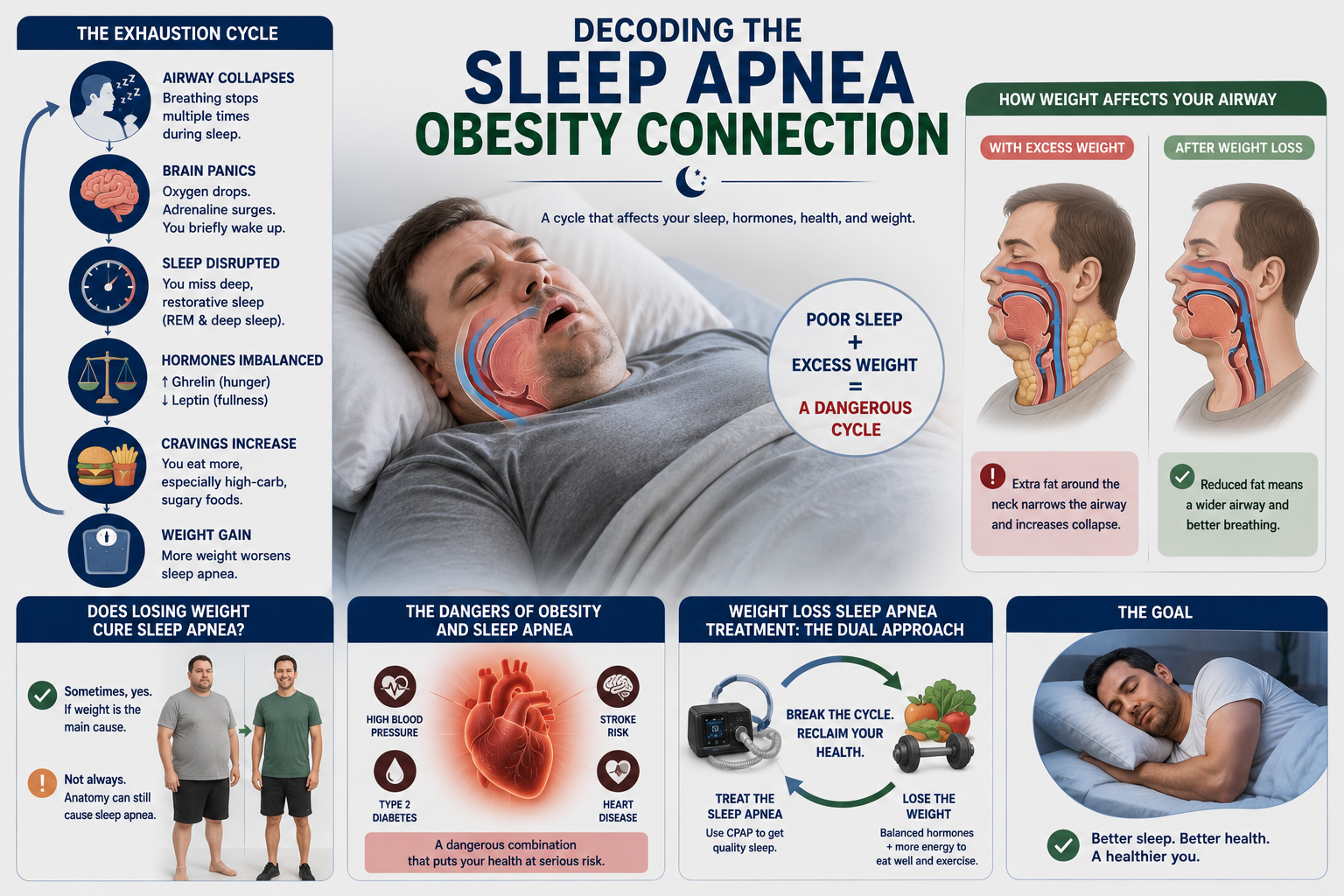
Decoding the Sleep Apnea Obesity Connection
To really grasp how weight loss and sleep apnea are linked, we have to look at the biology of exhaustion. The sleep apnea obesity connection isn’t just about physics; it’s highly chemical.
When your throat collapses at night, your brain panics because it’s starving for oxygen. It hits the panic button, shoots adrenaline into your bloodstream, and forces you to wake up just enough to take a breath. This can happen 50 to 100 times an hour. Because of this, you never hit the deep, restorative stages of REM sleep.
Here is where the weight gain happens: chronic sleep deprivation completely wrecks your metabolism. It causes your body to overproduce ghrelin (the hormone that makes you crave high-carb, sugary junk food) and suppresses leptin (the hormone that tells your brain you are full).
So, not only is your heavy neck crushing your airway at night, but the resulting lack of sleep is actively flooding your brain with chemicals that force you to overeat the next day. This is why willpower alone rarely works when you are dealing with an untreated sleep disorder. You are fighting your own hormones.
Sleep Apnea Surgery Dubai
When patients realize how tightly linked their weight is to their exhaustion, a few specific questions always come up. Let’s tackle them head-on.
Does Losing Weight Cure Sleep Apnea?
This is the holy grail question. Does losing weight cure sleep apnea? The honest answer is: sometimes, but not always.
If your condition is entirely driven by excess weight, then yes, achieving and maintaining a healthy weight can effectively cure the condition. Many patients drop 30 or 40 pounds and find they no longer need their CPAP machines. However, it is not a guaranteed cure for everyone. Sleep apnea can also be caused by craniofacial anatomy—meaning you might just have a naturally narrow throat, a recessed jaw, or enlarged tonsils. In those cases, losing weight will massively improve the severity of the apnea, but it might not eliminate it completely.
The Dangers of Obesity and Sleep Apnea
The combination of obesity and sleep apnea is incredibly dangerous for your heart. Every time your airway collapses, your blood oxygen levels plummet, and your blood pressure skyrockets. Carrying excess weight already puts a heavy load on your cardiovascular system. Adding the nightly trauma of oxygen deprivation significantly multiplies your risk for heart attacks, strokes, and Type 2 diabetes.
Weight Loss Sleep Apnea Treatment: The Dual Approach
Because of this catch-22, doctors rarely say "just go lose weight." A proper weight loss sleep apnea treatment plan involves treating the sleep disorder first.
Usually, a doctor will put you on a CPAP (Continuous Positive Airway Pressure) machine to physically hold your airway open. Once you start using the machine, you finally get high-quality sleep. Your hormones balance out, your cravings for junk food drop, and your energy levels come back to life. Suddenly, you actually have the physical and mental energy to exercise and cook healthy meals. You use the CPAP to gain the energy required to lose the weight, with the ultimate goal of losing enough weight that you no longer need the CPAP.
The Medical Mechanics
Let’s look at the specific terminology your doctor uses when discussing this issue.
The clinical term for this condition is obstructive sleep apnea (OSA). It is categorized under the broader umbrella of respiratory disorders because it fundamentally disrupts the way your body takes in oxygen. The root mechanism is a severe airway obstruction that happens exclusively when you are unconscious.
Doctors look very closely at a patient's BMI (Body Mass Index) when diagnosing and treating OSA. Studies consistently show a direct correlation: as BMI increases, the severity of the airway obstruction increases. In fact, medical research suggests that even a modest 10% reduction in body weight can lead to a 30% decrease in the severity of sleep apnea events. You don't have to become a fitness model to see massive medical benefits; just dropping a moderate amount of weight can change your life.
The Importance of a Specialist
You cannot tackle this dual problem alone, and frankly, relying on internet forums or generic diet plans isn't going to cut it when a medical respiratory issue is blocking your progress. You need a medical specialist who understands the complex intersection of weight, breathing, and sleep architecture.
If you live in or travel to the UAE, accessing a top-tier pulmonologist is crucial. Prof. Dr. Syed Arshad Husain is widely regarded as one of the most experienced respiratory experts in the region. Currently serving as a Lead Consultant Pulmonologist at Al Zahra Hospital Dubai, Dr. Husain brings over 30 years of deep clinical experience, much of it gained in the UK’s rigorous National Health Service (NHS).
When you consult a specialist of Dr. Husain’s caliber, you aren't just given a generic diet pamphlet. He conducts comprehensive diagnostic testing, including in-depth sleep studies, to see exactly how your airway is behaving at night. He evaluates your lung capacity, checks for overlapping respiratory issues, and creates a tailored, multi-step management plan. Dr. Husain understands that treating sleep apnea in overweight patients requires immense empathy and strategic medical intervention—often utilizing advanced CPAP or BiPAP therapies to stabilize your sleep before tackling the weight loss journey. His holistic approach ensures you are medically supported every step of the way.