Most people who come in with sleep apnea have been living with it for a while. Sometimes years. They managed the tiredness. They put the morning headaches down to stress. They assumed the snoring was harmless. Life carried on.
What they didn't realise was what was happening inside the body each night. Quietly. Repeatedly. Without any outward warning.
Sleep apnea doesn't just disrupt sleep. Left untreated, it puts steady, cumulative pressure on nearly every major system in the body. The effects build over time. And by the time they become obvious, some of the damage is already done.
Why Untreated Sleep Apnea Is a Whole-Body Problem
Each time breathing stops during sleep, oxygen levels in the blood drop. The brain detects this and briefly rouses the body to restore breathing. That happens dozens, sometimes hundreds of times a night.
Each episode triggers a stress response. The body releases adrenaline. The heart rate spikes. Blood pressure rises. Blood vessels tighten.
In the short term, those responses are protective. They get breathing going again. But when they happen repeatedly, night after night, for months or years, the cumulative load on the cardiovascular system, the brain, the metabolism, and the immune system becomes significant.
That's what makes untreated sleep apnea dangerous. Not any single moment, but the relentless repetition of it.
The Heart Bears a Heavy Load
Of all the systems affected, the heart takes some of the hardest hits.
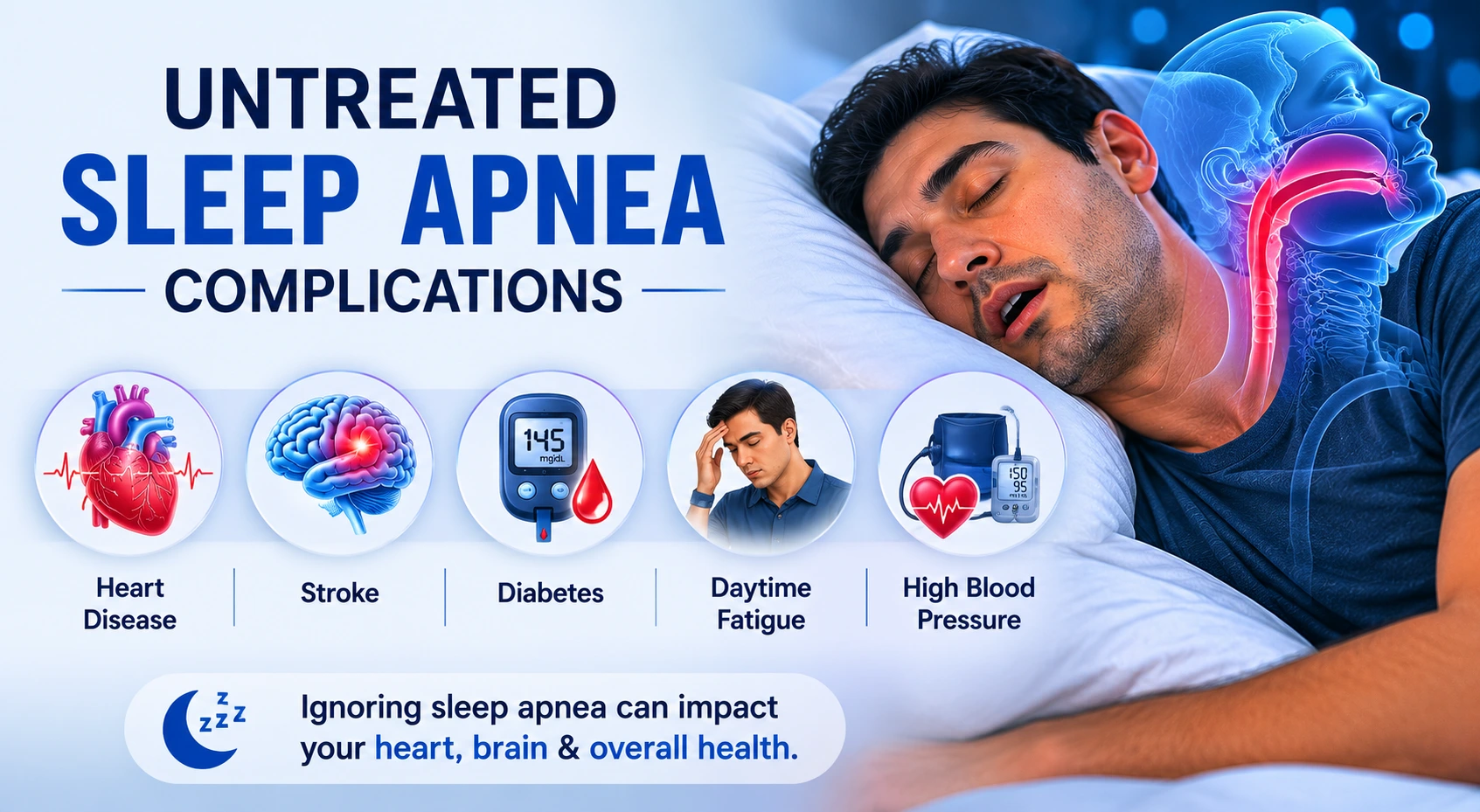
High blood pressure is one of the most consistent complications. The repeated spikes in blood pressure during sleep apnea episodes gradually push resting blood pressure higher over time. Many patients with difficult-to-control hypertension turn out to have undiagnosed sleep apnea sitting underneath it. Treating the sleep apnea often helps bring blood pressure down sometimes when medications alone haven't managed it.
Atrial fibrillation, an irregular heart rhythm, is closely linked to sleep apnea. The repeated drops in oxygen and the stress responses they trigger can disrupt the electrical signals that coordinate the heart's rhythm. People with untreated sleep apnea have a significantly higher rate of atrial fibrillation. And people with atrial fibrillation who also have sleep apnea tend to respond less well to treatment if the sleep apnea isn't addressed at the same time.
Heart failure is both a cause and a consequence. Sleep apnea can contribute to the development of heart failure over time. And in people who already have heart failure, untreated sleep apnea makes it considerably harder to manage.
The risk of heart attack is higher in people with untreated sleep apnea. So is the risk of dying from a cardiac event during sleep, a period when oxygen levels are already repeatedly compromised.
None of this is meant to alarm. It's meant to be honest about what the research consistently shows.
Stroke: A Risk That Often Goes Unmentioned
The link between sleep apnea and stroke is strong and well-established. Yet it's something many patients aren't told about.
The repeated drops in oxygen, the surges in blood pressure, and the changes to blood flow that happen during sleep apnea episodes all increase the risk of a blood clot forming or a blood vessel rupturing in the brain.
People with moderate to severe untreated sleep apnea have a substantially higher risk of stroke compared to people without it. That risk is present even when other factors like weight and blood pressure are accounted for.
After a stroke, untreated sleep apnea also slows recovery. The brain needs quality sleep to heal. Fragmented, oxygen-deprived sleep works against that process.
Early treatment reduces stroke risk. That's not a minor point.
What It Does to the Brain
Sleep is when the brain consolidates memory, clears metabolic waste, and restores the resources needed for the next day. Fragmented sleep disrupts all of that.
In the short term, the effects are familiar. Poor concentration. Difficulty finding words. Slower reactions. Trouble holding onto new information. A lot of patients describe it as thinking through fog.
Over the longer term, the picture becomes more concerning. Research has linked untreated sleep apnea to accelerated cognitive decline. People with long-standing, untreated sleep apnea show changes on brain imaging that suggest the brain is aging faster than it should.
The dementia link is still being actively studied, but the evidence is building. Repeated low oxygen during sleep appears to accelerate the kind of brain changes associated with Alzheimer's disease and other forms of dementia. The brain's overnight waste-clearance system which is most active during deep sleep is disrupted when sleep is fragmented night after night.
This doesn't mean sleep apnea inevitably leads to dementia. But it does mean that treating it is one of the modifiable things that can be done to protect brain health long term.
The Metabolic Connection
Sleep apnea and metabolic health are deeply connected and the relationship runs in both directions.
Untreated sleep apnea promotes insulin resistance. The stress hormones released during repeated apnea episodes interfere with how the body handles glucose. People with untreated sleep apnea develop type 2 diabetes at higher rates than those without it. And in people who already have diabetes, sleep apnea makes blood sugar harder to control.
Weight and sleep apnea also reinforce each other. Sleep apnea disrupts the hormones that regulate hunger and appetite specifically, it raises ghrelin (the hunger hormone) and reduces leptin (the fullness signal). People with untreated sleep apnea often find it harder to lose weight, even with genuine effort, because the hormonal environment is working against them.
Treating sleep apnea doesn't automatically resolve metabolic problems. But it removes a significant factor that keeps making them worse.
Mood, Mental Health and Daily Life
A lot of patients with untreated sleep apnea end up in treatment for anxiety or depression before anyone checks their sleep. It's understandable that the symptoms overlap considerably.
Chronic sleep fragmentation changes mood. It lowers emotional resilience. Small frustrations feel larger. Patience shortens. Motivation drops. Some people describe a flatness not quite depression, but a dulling of engagement with normal life.
Anxiety is common too. Waking repeatedly, even without remembering it, keeps the nervous system in a heightened state. The body doesn't fully settle into rest. Over time, that sustained low-level alertness contributes to anxiety symptoms during the day.
When mood symptoms are treated without addressing the underlying sleep disorder, results are often partial. The medications help a little, but the foundational problem remains. The fatigue and cognitive effects persist. And patients often continue struggling without understanding why.
On the Road: A Risk to Others Too
Excessive daytime sleepiness from untreated sleep apnea is one of the most underappreciated dangers.
People with moderate to severe untreated sleep apnea have a significantly higher rate of road accidents. In studies, the risk has been estimated at two to three times higher than in people without the condition. Reaction times are slow. Attention lapses. Microsleeps brief, involuntary moments of sleep can occur without warning.
Patients who drive long distances, operate machinery, or work in roles requiring sustained concentration carry a risk not just to themselves but to others. This is one reason why sleep apnea is taken seriously as a fitness-to-drive issue in many countries.
In Dubai, where long driving commutes are common and roads carry high traffic volumes, this is a real and practical concern.
What Happens to Relationships and Work
This part doesn't make it into medical textbooks. But it matters.
Loud snoring disturbs partners. Bed partners of people with sleep apnea often end up in separate rooms and their own sleep suffers. Relationships are strained by tiredness, irritability, and the accumulated tension that comes from months or years of disrupted nights.
At work, the effects are quieter but cumulative. Slower thinking. More errors. Less tolerance for pressure. Difficulty performing in demanding situations. Many people manage to function, but far below what they're capable of.
A significant number of patients say that after treatment they feel like a different person at work and at home. Not because treatment gave them something new, but because it gave back what the sleep apnea had been steadily taking.
Why Early Diagnosis Changes the Trajectory
The complications of untreated sleep apnea are not inevitable. Most of them are either preventable or reversible with the right treatment started early enough.
High blood pressure often responds to sleep apnea treatment. Irregular heart rhythm can stabilize. Cognitive symptoms frequently improve. Mood lifts. Weight management becomes more achievable. The risk trajectory for stroke and cardiac events shifts.
The longer sleep apnea goes untreated, the more time the body has to accumulate the effects. Some changes particularly in cardiovascular structure take longer to reverse and some may not fully reverse at all.
This is why the conversation about sleep apnea should happen sooner rather than later.
How Assessment Works
When patients come to Dr. Syed Arshad Husain at Al Zahra Hospital in Dubai, the evaluation covers the full picture.
Symptoms are reviewed in detail. How long has tiredness been present? What daytime functioning has been like. Whether headaches are a pattern. What a bed partner has observed. Medical history is examined for conditions that both contribute to and are worsened by sleep apnea, high blood pressure, heart conditions, diabetes, thyroid problems.
A sleep study is arranged when indicated. Most commonly this is done at home. It records what's happening to breathing, oxygen levels, and sleep across the night. Results guide the treatment plan.
Treatment is tailored. For most patients with moderate to severe obstructive sleep apnea, CPAP therapy is the first approach. For milder cases, other options may fit better. The goal isn't just a diagnosis, it's a plan that the patient can actually follow and that produces real improvement in how they feel.
Follow-up matters here. Checking that treatment is working. Adjusting if it isn't. Monitoring the medical conditions that overlap with sleep apnea over time.