Why Your Sleep Is Divided Into Different Stages
Your body doesn't treat every hour of sleep the same way. That would be a bit like a hospital running only one department across a full 24-hour shift. The brain and body have different needs, some related to physical repair, some to memory and emotional processing, some to basic physiological maintenance, and they handle these needs at different points through the night.
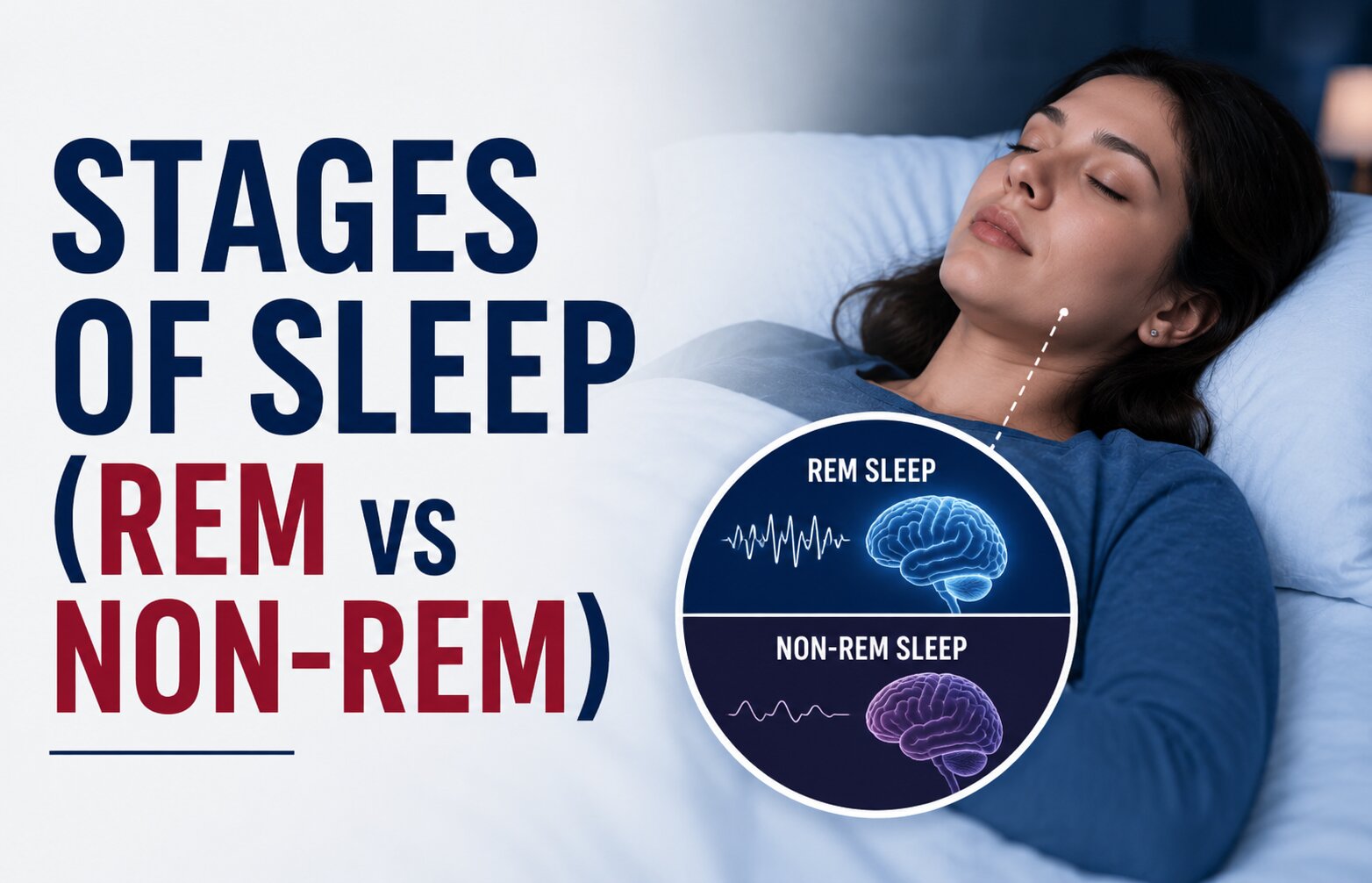
Sleep cycles through two broad categories: NREM sleep (non-rapid eye movement) and REM sleep (rapid eye movement). These alternate throughout the night in repeating cycles, each lasting roughly 90 minutes. A full night typically involves four to six of these cycles.
The proportion shifts as the night goes on. Early cycles are weighted toward deep NREM sleep. Later cycles give more time to REM. This is why the hours before 3 or 4 in the morning tend to be the most physically restorative, and the hours after that tend to involve more dreaming.
NREM Sleep: The Three Stages
Stage 1: The Doorway Into Sleep
This is the lightest stage. You've probably experienced that sensation of drifting off, then suddenly jerking awake from a feeling of falling. That's Stage 1.
It only lasts a few minutes. Your brain waves slow down, muscle activity reduces, and eye movements become slow and rolling. You're not fully asleep yet. A noise, a vibration, or someone saying your name can easily pull you back.
Stage 1 is a transition, not a destination. Spending too much time here, which can happen with certain sleep disorders, means you're not progressing into the deeper, more restorative stages where the real work begins.
Stage 2: Light Sleep With More Structure
Stage 2 is still classified as light sleep, but it's meaningfully different from Stage 1. Your body temperature drops. Your heart rate slows. Brain activity shows two very specific patterns that researchers look for: sleep spindles and K-complexes.
Sleep spindles are brief bursts of rapid brain activity. They appear to play a role in consolidating memories and in protecting sleep from disruption by external stimuli. K-complexes are single, high-voltage waves that seem to function as a kind of rapid response to disturbances, a way of staying asleep while briefly processing what's happening in the environment.
You spend more time in Stage 2 than in any other stage across a full night's sleep.
Stage 3 Deep Sleep (Slow-Wave Sleep)
This is the stage people are usually referring to when they talk about "deep sleep." It's also called slow-wave sleep because of the large, slow delta waves that dominate brain activity during this period.
Stage 3 is the most physically restorative phase of the sleep cycle. Growth hormone is secreted in its highest quantities here. Tissue repair accelerates. Blood pressure reaches its lowest point of the day. The immune system carries out a significant portion of its maintenance work. The glymphatic system, the brain's waste-clearing mechanism, is particularly active, flushing out proteins that have built up during waking hours.
Many patients are surprised to learn that if you wake someone during deep sleep, they often feel confused and disoriented for several minutes. That groggy, heavy feeling has a name: sleep inertia, and it reflects how deeply the brain has withdrawn from active engagement with the outside world.
REM Sleep: The Stage That Does More Than You Think
REM sleep is named for the rapid, dart-like eye movements that characterise it. It's the stage most associated with vivid dreaming. But it does considerably more than generate dreams.
During REM, the brain is intensely active in some measurements, as active as it is during wakefulness. Areas involved in emotion, memory, and sensory processing show high levels of activity. At the same time, the voluntary muscles are temporarily paralysed. This is a normal, protective mechanism. Without it, people would physically act out their dreams.
REM sleep plays a central role in emotional regulation and memory consolidation. It appears to be particularly important for processing emotionally significant experiences, helping to integrate them in a way that softens their impact. There's also good evidence that learning and skill retention improve with adequate REM sleep.
In patients with obstructive sleep apnea, REM sleep is frequently the most disrupted stage. Airway collapse and oxygen desaturation tend to be most severe during REM, partly because muscle tone, including airway muscle tone, drops further during this phase. This is one reason why people with untreated sleep apnea often feel emotionally flat, cognitively sluggish, and prone to mood disturbance even after spending a full night in bed.
How Sleep Cycles Change Through the Night
A single sleep cycle moves through Stage 1, Stage 2, Stage 3, back up through Stage 2, and then into REM. After that, the next cycle begins.
But each cycle isn't identical. The first half of the night is dominated by deep NREM sleep Stage 3. As the night progresses, REM periods become longer, and Stage 3 becomes shorter. By the early morning hours, most of the sleep consists of Stage 2 and REM.
This is why the timing of sleep disruption matters. Someone who consistently goes to bed late or wakes early is likely shortchanging their REM sleep even if the total hours in bed seem adequate. Someone whose sleep is repeatedly fragmented by apnea events, restless legs, or frequent waking may be cycling back to Stage 1 over and over again, never completing the full architecture of a healthy sleep cycle.
This is what's sometimes called poor sleep efficiency: spending time in bed without progressing through the stages in the way the body needs.
What Disrupted Sleep Architecture Actually Feels Like
Patients often describe it without realising what's causing it.
"I sleep, but it doesn't feel like sleep." "I dream all night and wake up more tired than when I went to bed." "I never feel fully rested no matter what I do."
These are descriptions of fragmented sleep architecture. The cycles are being interrupted. The body isn't completing its maintenance. And the consequences accumulate: reduced concentration, lower mood, physical fatigue, slower immune response, and over time, a measurable increase in cardiovascular and metabolic risk.
How Sleep Stages Are Measured
A polysomnography study, also called a sleep study, is the gold standard for measuring sleep stages. It records brain wave activity (EEG), eye movements, muscle activity, heart rhythm, breathing patterns, and oxygen levels simultaneously throughout the night. From that data, a specialist can see exactly how long a patient is spending in each stage, how often they're waking, and whether any breathing events are disrupting the cycle.
A home sleep test, while less comprehensive, can identify key respiratory disruptions and is a practical starting point for many patients who may have obstructive sleep apnea.
Key Takeaways
- Sleep cycles through NREM (stages 1, 2, and 3) and REM, repeating roughly every 90 minutes
- Stage 3 (deep sleep) is when the body physically repairs itself, and the brain clears waste.
- REM sleep handles emotional processing, memory consolidation, and dream activity
- The proportion of each stage shifts across the night; deep sleep dominates early; REM dominates later.
- Disrupted sleep architecture, not just insufficient hours, explains why many people wake feeling unrefreshed.
- Obstructive sleep apnea commonly fragments both deep sleep and REM, with significant health consequences.s
- A sleep study (polysomnography) is the most accurate way to evaluate sleep architecture.
Frequently Asked Questions
What are the four stages of sleep in order? The four stages are Stage 1 NREM (light transitional sleep), Stage 2 NREM (consolidated light sleep with sleep spindles and K-complexes), Stage 3 NREM (deep slow-wave sleep), and REM sleep. After REM, the cycle repeats. A full cycle takes approximately 90 minutes, and most adults complete four to six cycles in a night.
Which sleep stage is the most important? Every stage serves a purpose, so it's not entirely accurate to rank them. That said, Stage 3 deep sleep is considered the most physically restorative when tissue repair, hormone secretion, and brain waste clearance are at their peak. REM sleep is equally critical for mental and emotional health. Consistently losing either one has measurable consequences.
What is the difference between REM and non-REM sleep? NREM sleep covers stages 1 through 3 and is characterised by progressively slower brain waves and increasing physical restoration. REM sleep involves a highly active brain, temporary muscle paralysis, and vivid dreaming. The two alternate in cycles throughout the night, with NREM dominating the first half and REM occupying more of the second half.
How much deep sleep do you actually need? Most adults get roughly 15 to 20 percent of their total sleep time in deep sleep (Stage 3). For someone sleeping seven to eight hours, that works out to approximately 90 to 110 minutes. Deep sleep tends to decrease with age, which is one reason older adults sometimes feel their sleep is less restorative than it used to be.
Concerned About Your Sleep Quality?
If you regularly wake up feeling unrefreshed, if your sleep feels shallow or fragmented, or if someone has mentioned that you snore or stop breathing at night, your sleep architecture may be affected by an underlying sleep disorder.
Prof. Dr. Syed Arshad Husain is a consultant pulmonologist and sleep medicine specialist in Dubai with over 30 years of clinical experience. He offers full sleep evaluations, including in-lab sleep studies and home sleep testing, to identify exactly what is happening during your sleep cycles and provide a diagnosis-led treatment plan.
Reach out to the hospital to book a consultation, or visit the Sleep Apnea service page for more information on diagnosis and treatment options available in Dubai.