Have you found yourself waking up well-rested yet exhausted after eight full hours of sleep? Do your loved ones complain all the time about your loud snoring and your inability to remain alert at daytime work meetings? If this rings a bell for you, you may have been advised by your doctor to undergo some sleep test.
What is it all about then? The very name can be perceived as clinical and a bit scary. Most people who hear about it imagine themselves connected to various devices in an uncomfortable hospital room, unable to fall asleep. Actually, it is not quite as frightening as it may seem. Let us get you prepared for all you need to know. You are looking for a complete explanation of the sleep study test, and we have got you covered. Here we will discuss what a sleep study test is, what happens during the night and how to find help.
What is a sleep study test?
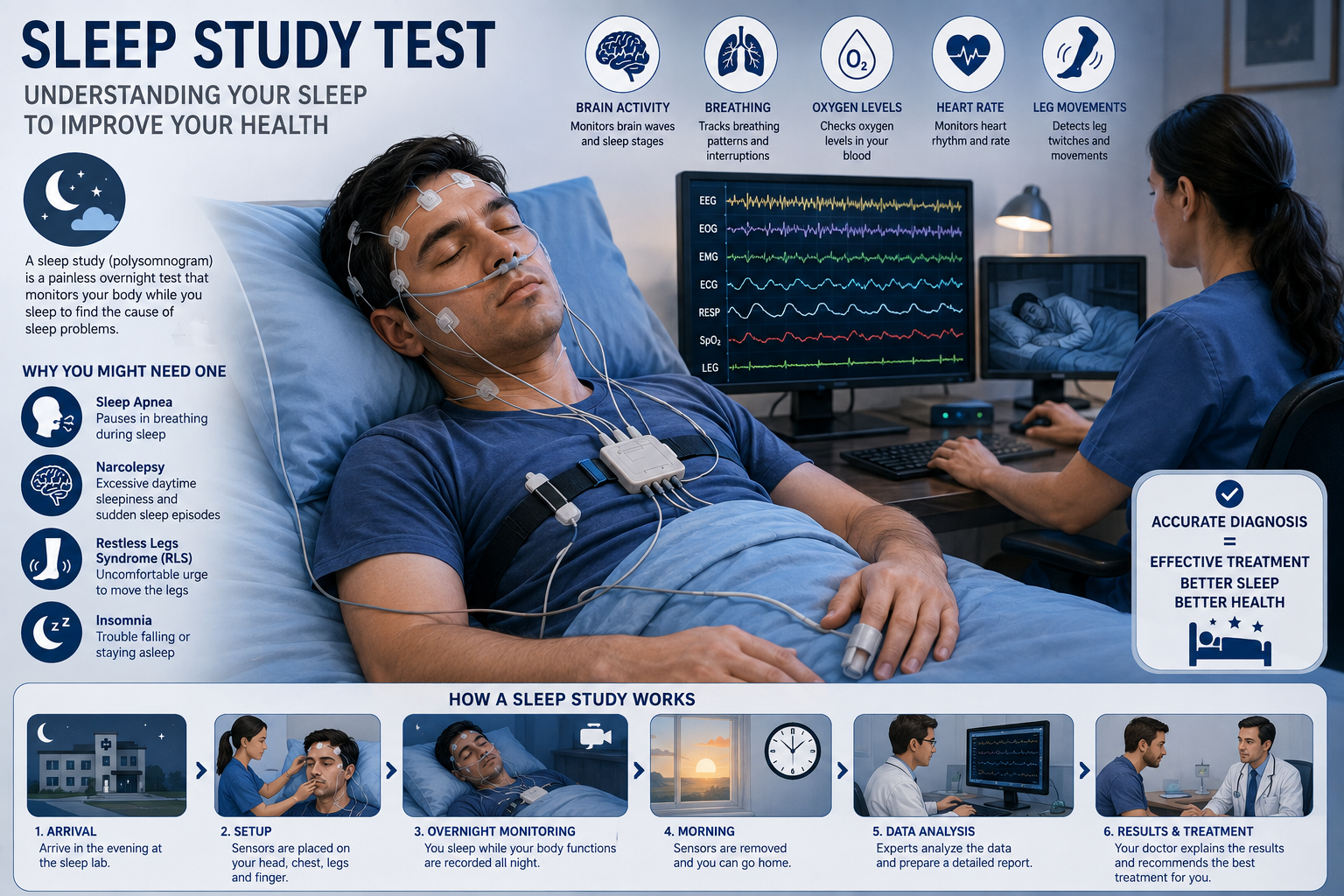
A complete study of your sleep in medicine is called a polysomnogram. In essence, this is a completely painless test that monitors your physiological functions during sleep. Consider it a highly detailed journal of your sleep written by means of various medical devices, not a pen and paper.
Of course, it is not simply aimed at checking whether you will be able to fall asleep or not. The main purpose of this test is to check your sleep quality and to find out what kind of disturbances interfere with your rest and make you tired. Various special devices monitor your brainwaves, the oxygen content in your blood, your heartbeats, breathing, your eyes movements and even twitching of your legs. Based on this information, a professional can tell exactly why you feel tired after sleeping.
Why might you need one?
People do not simply choose to do this test randomly one day out of the blue; typically, there are obvious warning signs that make a doctor prescribe such a test. By far the most frequent reason all around the world is OSA.
With this condition, the muscles in the back of the throat tend to relax slightly during sleep, thereby closing your air passages. Effectively, you will stop breathing for a few seconds, your brain will panic for a moment and make you wake up, thus restarting your breathing process. And this whole cycle can repeat numerous times each hour! The bad news is that you may not even notice that the next morning; all you will experience is extreme fatigue.
Some other conditions for which your doctor might prescribe such a test include:
- Narcolepsy: Neurological disorder characterised by excessive daytime sleepiness and abrupt sleep episodes.
- Restless legs syndrome (RLS): Uncomfortable and irresistible urge to move one’s legs, especially when going to bed.
- Insomnia: inability to fall or stay asleep despite having opportunities (although not always necessary, a study helps differentiate physical conditions).
If you are dealing with excessively loud snoring, morning headaches, waking up gasping for air, or extreme daytime fatigue, these are strong signs that an evaluation is overdue.
How does a sleep study work? The Overnight Experience
If you’re getting one of those tests where we do things during a long nap, you’ll probably be doing an overnight sleep study at a specialised clinic or a hospital’s sleep lab. These studies generally happen between 8- 11 PM depending on when they need you, but I always find it helpful to have my usual bedtime snacks available. Bring along your comfy night suits and your favorite pillow, if possible, along with whatever books you’d like to read while lying about. If you like to brush your teeth before going to sleep, make sure to bring along your toothbrush.
When you’re ready for bed, a trained “sleep technologist” will come in and put little sensors (“electrodes”) on your scalp, temples, chest, and legs to monitor various bits of brain activity and body movement. You also might have a little clip attached to either your finger or earlobe to track your blood oxygen levels, as well as some lightweight elastic bands strapped around your chest and stomach to pick up how hard you’re working to breathe.
There may seem like a lot of wires coming out of you but trust me, once everything gets plugged in, there are enough cables bundled together that you can actually roll around in bed and don’t worry if you have to pee during the night you can let the techs know via intercom that you need to pee and they’ll happily unplug your big cable bundle so you can safely walk outside without interrupting the data collection. They stay up all night while we get some shut-eye. They monitor us using a computer and low-light video camera.
In the morning (usually at 6:00 AM), they will remove their sensors for us and give us complete freedom. We’re free to grab our favourite coffee, shower, head off to work or whatever we need to do.
What happens after the test?
Once your test is done, there’s no immediate result, but that doesn’t mean your results disappear into some black hole overnight.
First off, the amount of data collected through one night’s sleep is immense. A technologist has to go through everything, highlighting all sorts of things. They’ll note which sleep stages you were going through — say how much time was spent in REM and deep sleep. They’ll also pick up on any issues happening, whether it’s abnormal drops in your oxygen or breathing pauses.
A sleep specialist then reviews your whole report to come to an official diagnosis. Once they’ve got their results, you’ll likely be offered a follow-up meeting where you can talk about the results.
For example, if you’re diagnosed with something like obstructive sleep apnea, your doctor may run through the various treatment options available, including lifestyle changes, oral appliance uses and even the good old trusty CPAP machine designed to keep your airway open when you sleep at night.
Getting a Sleep Study Test Dubai
You need to have an experienced expert who can help you out. It is very important because when we talk about sleep disorders, every little thing matters. We are here to recommend one of the best doctors for all types of respiratory issues, such as Prof. Dr Syed Arshad Husain.
Prof. Dr Syed Arshad Husain has been working as a Lead Consultant Pulmonologist at Al Zahra Hospital Dubai for many years now. With over 30 years of extensive experience in the UK's National Health Service (NHS), He has also worked as a consultant in Respiratory Medicine for more than 18 years. At His Clinic, they handle advanced assessment & targeted treatment for all types of sleep-related breathing disorders, including comprehensive care for sleep apnea syndrome. He is considered among the best doctors for Sleep Apnea Syndrome Dubai due to his expertise in treating this condition.
So, if you’re experiencing Chronic Fatigue, loud snoring, or suspected sleep apnea, then you should definitely schedule a consultation with him to be properly evaluated. Explore his patient resources, read his Latest Medical Blogs on Sleep Apnea and Book Appointment Easily Through His Website.