There's a persistent idea that sleep apnea is something that happens to middle-aged men who are overweight. That image has stuck around for a long time. And it means a lot of young adults with real sleep problems never think to ask whether sleep apnea could be the cause.
It can be. And it is, more often than people realise.
We see patients in their twenties and thirties with confirmed sleep apnea. Some are athletes. Some are lean. Some had no idea the condition could affect them at all. By the time they come in, many have been dealing with the symptoms for years without connecting them to anything specific.
That delay has consequences. Sleep apnea at any age puts strain on the heart, the brain, and metabolic health. Starting that strain in your twenties means more cumulative damage by the time it's eventually found.
Understanding why sleep apnea happens in young adults is the first step to catching it earlier.
Why Young People Aren't Immune
Sleep apnea isn't caused by age. Age is a risk factor because muscle tone reduces and weight tends to accumulate over time. But the underlying mechanism, an airway that collapses or narrows during sleep, can happen at any age if the conditions are right.
For young adults, those conditions often come down to anatomy, weight, or a combination of both.
Some people are simply born with a narrower airway. A jaw that sits further back than usual, a larger tongue relative to the mouth, a high and arched palate, or tonsils that never fully reduced after childhood. These are structural features. They don't announce themselves during the day. But when muscles relax during sleep and gravity does its work, a naturally narrower airway closes more easily.
Weight matters too. Obesity rates among young adults have risen significantly over recent decades. Excess weight around the neck and upper body puts pressure on the airway from the outside. Fat tissue around the throat walls reduces the available space. Sleep apnea can develop in someone in their mid-twenties if the combination of anatomy and weight tips past a threshold.
These aren't rare scenarios. They're happening quietly, in a group of people who don't expect to have this kind of problem.
Why Young Adults Rarely Suspect It
Part of the problem is how sleep apnea gets described in popular conversation. Loud snoring. A middle-aged partner sleeping separately. Someone who visibly gasps or stops breathing at night. A larger man who's been told by his doctor to lose weight.
Young adults don't always fit that picture. A twenty-five-year-old who's tired all the time tends to explain it differently. Studying too late. Work stress. Not going to bed early enough. A social life that cuts into sleep. There's always an alternative explanation that feels more plausible at that age.
So the symptoms get lived with. Fatigue becomes the baseline. Waking up without feeling rested just becomes normal. Brain fog in the morning gets put down to not being a morning person.
Some young patients mention the tiredness to a GP and get told to sleep more or reduce stress. Sleep apnea isn't always on the list of possibilities for a twenty-eight-year-old.
It should be.
What the Symptoms Look Like in This Age Group
The symptoms of sleep apnea in young adults are the same as in any age group. But the way they show up in daily life looks different because of the context.
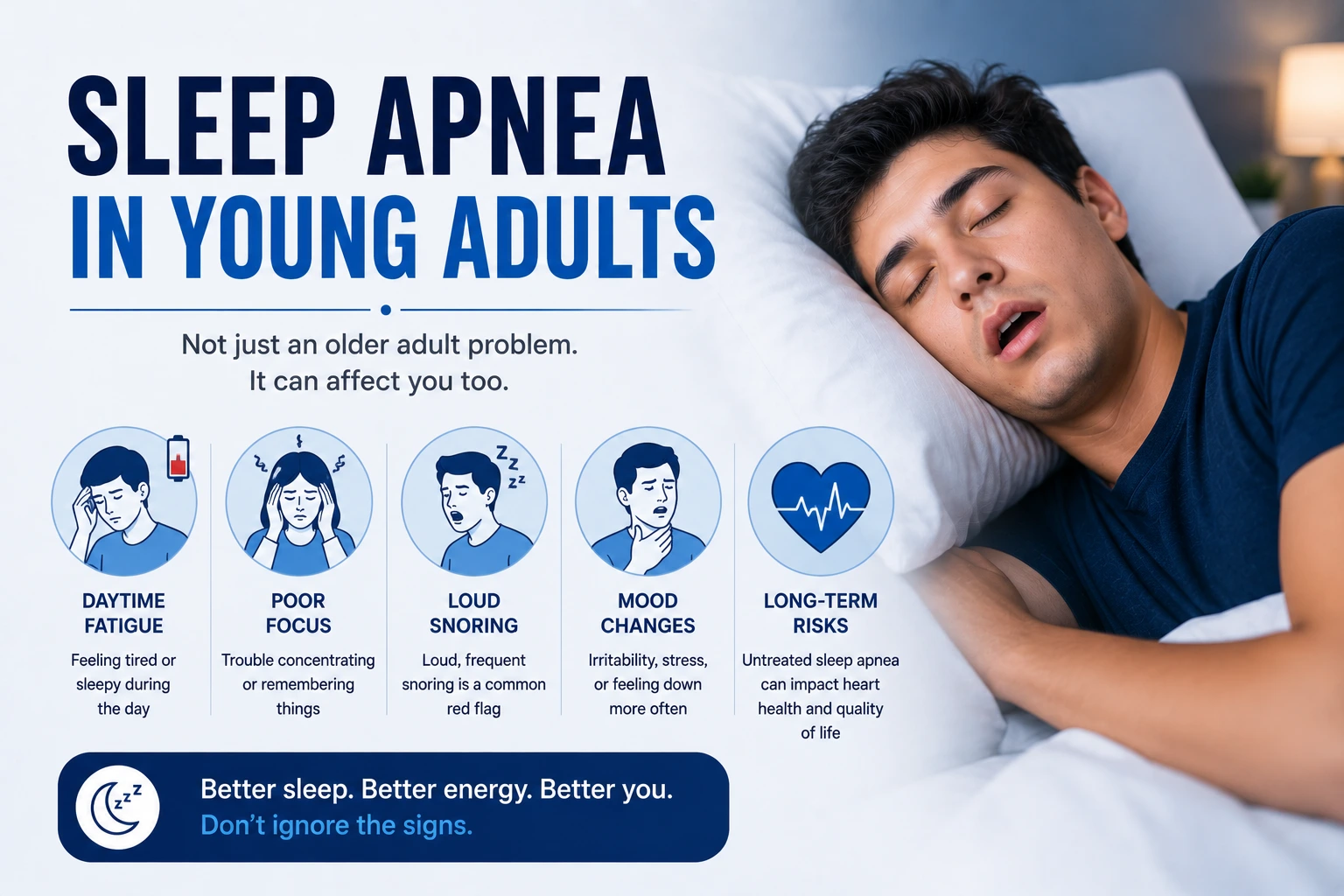
Persistent tiredness is the most common one. Not occasional. Not linked to a late night. A constant low-level exhaustion that doesn't fully lift even after a full night of sleep. Young adults with sleep apnea often describe going to bed tired and waking up tired. Every morning.
Difficulty concentrating is significant. Many young adults in this situation describe struggling to hold attention during lectures or work meetings. Reading the same paragraph multiple times. Losing track of conversations. Some have been assessed for attention deficit disorders before anyone considered a sleep problem.
Morning headaches are common and often ignored. They tend to clear through the morning, which makes them easy to brush off. But they're a consistent pattern in undiagnosed sleep apnea across all ages.
Mood changes show up too. Irritability that feels disproportionate. Low mood that doesn't have a clear cause. Reduced motivation and a flattened emotional range. In young adults, these often get attributed to stress, anxiety, or depression without the underlying sleep disorder being investigated.
Snoring at a young age is worth paying attention to. Not everyone with sleep apnea snores loudly. But if a flatmate, partner, or family member has mentioned it, particularly if it's been going on for a while, it's relevant information.
Some young patients describe waking up with a very dry mouth. Others notice they often need the bathroom at night despite not drinking much before bed. A few describe waking from sleep with a sense of gasping, though they don't always connect this to anything medical.
These symptoms together should prompt investigation. Any single one on its own in a young person doesn't necessarily mean sleep apnea. But several of them together, particularly with tiredness as the backdrop, warrants a proper assessment.
Athletes and Sleep Apnea: A Surprising Overlap
This is something that surprises people.
Sleep apnea in athletes exists and is probably underrecognised. Rugby players, American football players, and other athletes in contact sports develop sleep apnea at higher rates than the general population. Some of this is linked to neck size and upper body mass. Athletes who build significant muscle around the neck and upper body can experience the same external airway pressure as those with fat in the same area.
But it isn't just contact sports or heavy-build athletes. Endurance athletes have been found to have sleep apnea too. The mechanism here may involve changes to how the brain regulates breathing, particularly in people who train very heavily.
What makes this group especially likely to miss the diagnosis is performance framing. An athlete who is fatigued assumes they're overtrained or under-recovered. They adjust training loads, nutrition, and hydration. They rarely consider that poor sleep quality from undiagnosed sleep apnea might be limiting their recovery and performance.
Some athletes describe a plateau they can't break through despite doing everything right. Sleep apnea affecting overnight recovery could be a factor that no amount of training adjustment will fix.
If you train consistently and still feel like you're never fully recovered, sleep quality is worth looking at specifically.
PCOS and Sleep Apnea in Young Women
Young women with polycystic ovary syndrome have a significantly higher rate of sleep apnea than women of the same age without it. The hormonal profile of PCOS, including elevated androgens, appears to increase the tendency for airway collapse during sleep. Insulin resistance and weight gain associated with PCOS also contribute.
This matters because PCOS is common. It affects roughly one in ten women of reproductive age. Sleep apnea as a complication of PCOS is frequently unrecognised.
Young women with PCOS who experience significant fatigue, poor sleep quality, or difficulty concentrating should specifically ask about sleep apnea as part of their care. It won't be picked up through routine PCOS management unless someone thinks to look for it.
Enlarged Tonsils in Adults: A Cause That Often Gets Overlooked
Most people think tonsils are a childhood concern. But enlarged tonsils persist into adulthood for some people, and when they do, they directly narrow the airway at the throat.
A young adult with enlarged tonsils who snores and feels persistently tired may have obstructive sleep apnea driven significantly by that structural factor. If a sleep study confirms the diagnosis and tonsil size is identified as a major contributor, removing them can produce dramatic improvement. Sometimes complete resolution.
This is worth assessing during the physical examination. It's a simple thing to check and a potentially very treatable cause in the right patient.
What Happens If It Goes Untreated in Your Twenties
Untreated sleep apnea at any age puts ongoing strain on the cardiovascular system, the brain, and metabolic health. But starting that strain in your twenties means it runs for longer before it's detected.
High blood pressure can develop earlier than it otherwise would. Insulin resistance builds up. Cognitive effects accumulate quietly, affecting memory, processing speed, and emotional regulation over years. The cardiovascular risk that builds up over a decade of untreated sleep apnea in a young person is not trivial.
There are also the immediate life effects. Poor performance at work or university. Strained relationships from irritability and fatigue. Missing out on the social and physical energy that your twenties and thirties should involve. Young adults with untreated sleep apnea often look back after treatment and realise how much of that period was spent functioning below what they were capable of.
Getting diagnosed young is an advantage, not a problem. It means more years of better sleep, better health, and better function going forward.
Getting Assessed as a Young Adult
A sleep assessment for a young adult follows the same process as for anyone else. A detailed consultation covering symptoms, lifestyle, medical history, and family history. A physical examination that includes the throat, jaw, and airway. A home sleep study if indicated.
The home sleep study is done overnight in your own bed. It records breathing patterns, oxygen levels, and sleep data. It doesn't require a hospital stay. Results come back within a few days.
For young adults in Dubai, the practicalities are manageable. The home test fits around a working week or university schedule. The consultation is typically an hour. Results and treatment planning follow shortly after.
At Al Zahra Hospital in Dubai, Dr. Syed Arshad Husain assesses patients across all age groups. Young adults with sleep symptoms aren't an unusual presentation in a clinic. The evaluation is thorough and the treatment plan is matched to the individual's situation, including age, lifestyle, and whatever is specifically driving the sleep apnea in their case.
Treatment for young adults doesn't automatically mean CPAP for life. For patients where anatomy is the primary driver, structural approaches are explored. For those where weight is a factor, that's part of the conversation. For patients with enlarged tonsils, the appropriate specialist is involved. The treatment should fit the cause, not just the diagnosis.