Most people picture sleep apnea as a middle-aged man who snores loudly and wakes up gasping. That image has stuck around for a long time. And it's done a lot of harmbecause it's led countless women to dismiss their own symptoms, and some doctors to overlook them too.
Sleep apnea in women is real. It's common. And it often looks quite different.
Why Women Slip Through the Cracks
When sleep apnea research was first conducted decades ago, the study populations were overwhelmingly male. The symptoms described, the criteria used for diagnosis, the "typical patient"all of it was built around men. That has gradually been corrected, but the legacy remains.
Women with sleep apnea are still underdiagnosed at a significant rate. Some estimates suggest women are diagnosed at roughly half the rate of men with comparable sleep disruption. Part of that is biological women do have a lower overall rate of the condition before menopause. But a large part of it is simply that the symptoms present differently, and they're easier to explain away.
Fatigue gets attributed to a demanding job or family life. Mood changes get labelled as anxiety or depression. Poor sleep gets treated as insomnia. Morning headaches get ignored. The actual cause/disrupted breathing during sleep never gets investigated.
That gap in diagnosis has real consequences.
What Sleep Apnea Actually Does at Night
To understand why this matters, it helps to understand what's happening during sleep.
In obstructive sleep apnea, the muscles of the throat relax during sleep and the airway narrows or collapses. Breathing slows or stops. Oxygen levels drop. The brain registers the problem and briefly wakes the body to restore breathing. This cycle repeats sometimes dozens of times per hour.
The person waking up in the morning has no memory of this. They just feel drained. Unrefreshed. Like sleep didn't do anything.
Women with sleep apnea often have what's called a more "subtle" pattern: the airway narrows and restricts breathing without fully collapsing. Oxygen levels still drop. Sleep still fragments. But the dramatic choking or gasping episodes that are typically associated with sleep apnea may not be as obvious. So it goes unnoticed.
The Symptoms Women Actually Experience
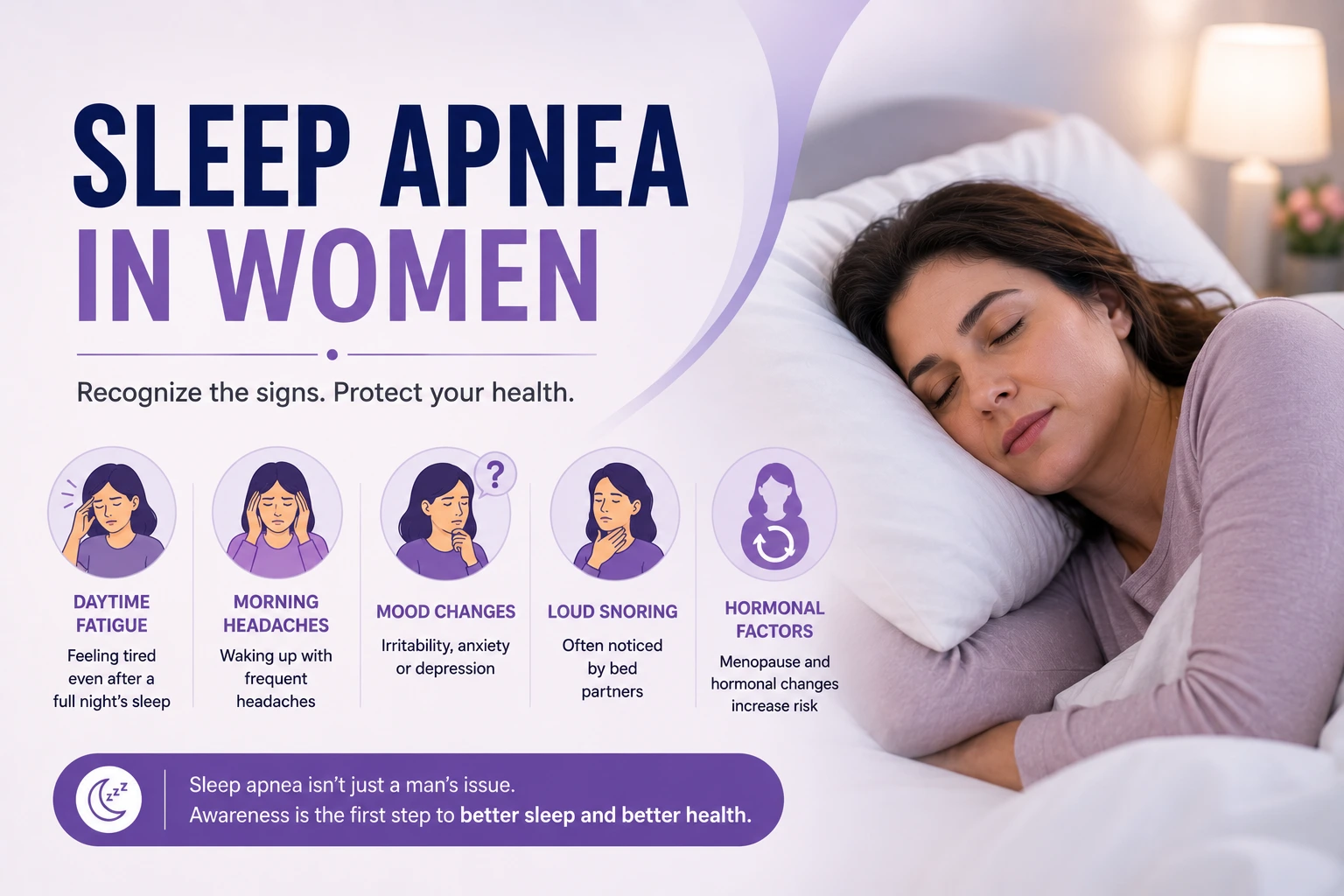
Loud snoring is one of the most recognised signs of sleep apnea. But women who have it may snore more quietly or not at all, at least not in a way that draws attention. And they're often less likely to have a bed partner who flags it up in the first place.
What women do tend to report, consistently, is:
Waking up tired every morning, no matter how long they slept. This is one of the most common things we hear. Eight hours in bed and still exhausted.
Low energy throughout the day. Not just the afternoon slump, a persistent, heavy fatigue that makes concentration difficult and motivation feel out of reach.
Mood changes that don't have an obvious explanation. Irritability. Feeling low. Heightened anxiety. These are real symptoms of disrupted, non-restorative sleep but they're frequently attributed to stress, hormones, or mental health before anyone thinks to check breathing.
Waking up with headaches. Particularly across the forehead or at the back of the head. These are caused by the drop in oxygen that happens repeatedly during the night.
Waking frequently to use the bathroom, to shift position, for no clear reason. The brief arousals from sleep apnea episodes often feel like light sleeping or difficulty staying asleep rather than breathing problems.
Brain fog. Trouble finding words. Forgetting things. Slower processing. This is one of the more distressing symptoms for many women, and one of the least connected to sleep in their own minds.
None of these are specific to sleep apnea. That's exactly why they're easy to miss. And that's exactly why a proper evaluation matters.
How Hormones Play a Major Role
One of the clearest differences between sleep apnea in women and men comes down to hormones.
Oestrogen and progesterone both appear to protect the airway. They help maintain tone in the muscles that keep the throat open during sleep. They also influence how the brain controls breathing. While these hormones are activeparticularly before menopausewomen have some natural protection against airway collapse.
After menopause, that changes.
When oestrogen and progesterone levels fall, the protective effect reduces. Airway muscles lose some of their tone. The brain's respiratory control shifts. Sleep architecture changes to less deep sleep, more frequent awakenings, more time in lighter sleep stages when breathing is more vulnerable.
The result is a significant rise in sleep apnea risk after menopause. Some research suggests that post-menopausal women have rates of sleep apnea three to four times higher than pre-menopausal women of similar age and weight. Their risk starts to look much more like that of men the same age.
Many women going through menopause already expect sleep disturbance, hot flushes, night sweats, insomnia. Those are real. But sleep apnea can sit alongside them, quietly making everything worse, and go undetected because it blends in.
If your sleep deteriorates significantly around the time of menopause, and fatigue has become a persistent problem, sleep apnea is worth ruling out specifically.
PCOS and the Sleep Apnea Connection
Polycystic ovary syndromePCOSis one of the most common hormonal conditions in women of reproductive age. And it carries a meaningfully elevated risk of sleep apnea.
Women with PCOS have higher levels of androgen/male-type hormones which appear to increase the tendency for airway collapse during sleep. They also have higher rates of insulin resistance and weight gain around the abdomen and neck, both of which are independent risk factors for sleep apnea.
Studies have found that women with PCOS have a substantially higher rate of sleep apnea compared to women without the condition, even after accounting for body weight. It's not purely a weight issue.
This matters because PCOS is often managed by gynaecologists or GPs, and sleep apnea isn't always part of the conversation. Women with PCOS who experience significant fatigue, poor sleep quality, or mood difficulties should have a sleep evaluation, not just blood tests and lifestyle advice.
The two conditions can reinforce each other. Sleep apnea disrupts glucose regulation and can worsen insulin resistance. Managing sleep apnea can actually help improve some of the metabolic aspects of PCOS.
Pregnancy and Sleep-Related Breathing
Pregnancy changes breathing in several ways. The growing uterus pushes upward on the diaphragm, reducing lung capacity. Weight gain increases pressure on the airway. Hormonal changes cause nasal congestion in many women. Blood volume increases, which can lead to fluid accumulation around the airway.
Sleep-disordered breathing during pregnancy is more common than many people realise. It's been linked to higher rates of gestational diabetes, high blood pressure in pregnancy, and poorer outcomes for the baby's growth and development.
Snoring that develops or worsens during pregnancy isn't something to simply accept. If it's accompanied by fatigue, morning headaches, or frequent waking, it should be mentioned to the doctor managing the pregnancy.
An overnight sleep study can be done safely during pregnancy when indicated, and treatment options that are appropriate for pregnancy do exist.
When It Gets Mistaken for Something Else
This is one of the most important things to understand. Sleep apnea in women is frequently misdiagnosed or rather, the symptoms are attributed to other conditions without the underlying cause being found.
Depression and anxiety are both linked to sleep apnea but the relationship isn't straightforward. Sleep apnea can cause mood changes that look exactly like anxiety or depression. Treating the mood symptoms without addressing the broken sleep doesn't resolve the problem. And it's not uncommon for women to spend years on medications for anxiety or depression that only partially help, because what's actually driving their symptoms is poor oxygen levels and fragmented sleep overnight.
Chronic fatigue syndrome and fibromyalgia are other conditions that can overlap with undiagnosed sleep apnea. The symptoms, exhaustion, pain, brain fog, difficulty concentrating overlap considerably. Some women have both. But sleep apnea alone can produce a picture that looks very similar.
Insomnia is another common misdiagnosis. Difficulty staying asleep, frequent waking, and not feeling rested in the morning are all common insomnia symptoms. They're also symptoms of sleep apnea. The distinction matters because treatment is entirely different. Standard sleep hygiene advice and sleep restriction therapy won't help if breathing is being disrupted forty times an hour.
If you've been told you have insomnia, anxiety, or depression and the treatment hasn't fully resolved your tiredness and sleep problems, sleep apnea is worth investigating. It's not always the answer, but it's missed often enough that it deserves to be checked.
Risk Factors Specific to Women
Beyond the hormonal picture, several other factors raise sleep apnea risk in women:
Weight, particularly around the neck and upper body, is a significant factor as it is in men. But women can develop sleep apnea at lower body weights than men because of differences in airway anatomy and the loss of hormonal protection.
Thyroid conditions are more common in women. An underactive thyroid can cause weight gain, reduced muscle tone throughout the body, and fluid changes around the airway all of which make sleep apnea more likely.
Age is a straightforward risk factor. As muscle tone reduces and hormone levels shift, sleep apnea becomes more common with each decade.
Anatomy matters too. A narrow jaw, a naturally smaller airway, enlarged tonsils, or a deviated nasal septum can all contribute in women just as in men.
And lifestyle factorsalcohol in the evening, sedative medications, sleeping on the back can all worsen breathing during sleep, regardless of sex.
The Importance of Getting an Accurate Diagnosis
An overnight sleep study is the only reliable way to know whether sleep apnea is present and how significant it is. It measures how many times breathing is disrupted, how long those interruptions last, and how much oxygen levels drop overnight.
This can often be done at home now. It doesn't require a hospital admission. The device is worn overnight and returned the next day. It's less disruptive than many patients expect.
At his clinic at Al Zahra Hospital in Dubai, Dr. Syed Arshad Husain evaluates each patient thoroughly before recommending a sleep study. That evaluation includes a detailed history, a review of symptoms, an assessment of relevant medical conditions, and a physical examination.
For women, that history specifically covers where they are in relation to menopause, any history of PCOS or thyroid conditions, changes in sleep quality over time, and the full pattern of symptoms, not just snoring.
The aim is an accurate diagnosis, not just a confirmed one. Because the way sleep apnea is treated should reflect its causes and the individual patient, not just a generic plan.
What Treatment Looks Like
CPAP therapy is still the most widely used treatment for moderate to severe sleep apnea. It delivers gentle air pressure through a mask during sleep, keeping the airway open. Many women find it takes a few weeks to adjust to but for those who do, the improvement in energy, mood, and cognitive function can be striking. Often within days.
For milder sleep apnea, a custom oral device worn during sleep can reposition the jaw and keep the airway open. This suits some patients better than CPAP.
Lifestyle changes, weight management, reducing alcohol before bed, changing sleep position, rarely resolve sleep apnea on their own, but they can meaningfully reduce its severity and improve treatment outcomes.
For women whose sleep apnea appears closely tied to menopause, the relationship with hormone changes is worth discussing with the relevant specialists. This doesn't mean hormone therapy is automatically appropriate, but it's part of a complete picture.
If a contributing medical condition like hypothyroidism or PCOS is identified, managing that condition is part of the overall approach not separate from it.
Treatment isn't one decision made at one appointment. It involves follow-up, adjustment, and checking that what's been prescribed is actually working.
What Life Looks Like After Treatment
Many women describe a shift that feels like coming back to themselves.
The heavy fatigue that had become normal lifts. Mornings feel different. Concentration returns. Mood stabilises in a way that antidepressants alone never quite achieved. The brain fog clears. Relationships that were strained by irritability and exhaustion recover.
These outcomes aren't guaranteed, and they don't happen overnight. But they are common. And they're possible at any age.
Sleep apnea is a manageable condition. But you can't manage what hasn't been diagnosed.