Sleep apnea is one of those conditions that quietly changes your life before you even realise something is wrong. You wake up tired. Your partner says you snore. You get through the day on coffee and willpower. For a long time, people assume it's just stress or a busy schedule. But something else is often going on.
Understanding the causes of sleep apnea is the first step. And there are more of them than most people expect.
What Exactly Happens During a Sleep Apnea?
When you fall asleep, the muscles around your throat naturally relax. In most people, that's fine. The airway stays open, breathing continues, and sleep moves through its normal cycles undisturbed.
But for many people, that relaxation goes a step further. The airway narrows sometimes partially, sometimes almost completely. Breathing slows. Oxygen levels drop. The brain senses a problem and wakes the body just enough to restore normal breathing. Then it happens again. And again. Sometimes dozens of times an hour.
Most people have no memory of these micro-awakenings. But the body does. That's why you feel exhausted even after eight hours in bed.
There are two main types. Obstructive sleep apnea, which is by far the most common, happens when the airway physically collapses or becomes blocked. Central sleep apnea is different here, the airway is fine but the brain simply doesn't send the right signals to the breathing muscles. Some people have a mix of both.
Each type has its own set of causes. And sometimes they overlap.
When the Airway Itself Is the Problem
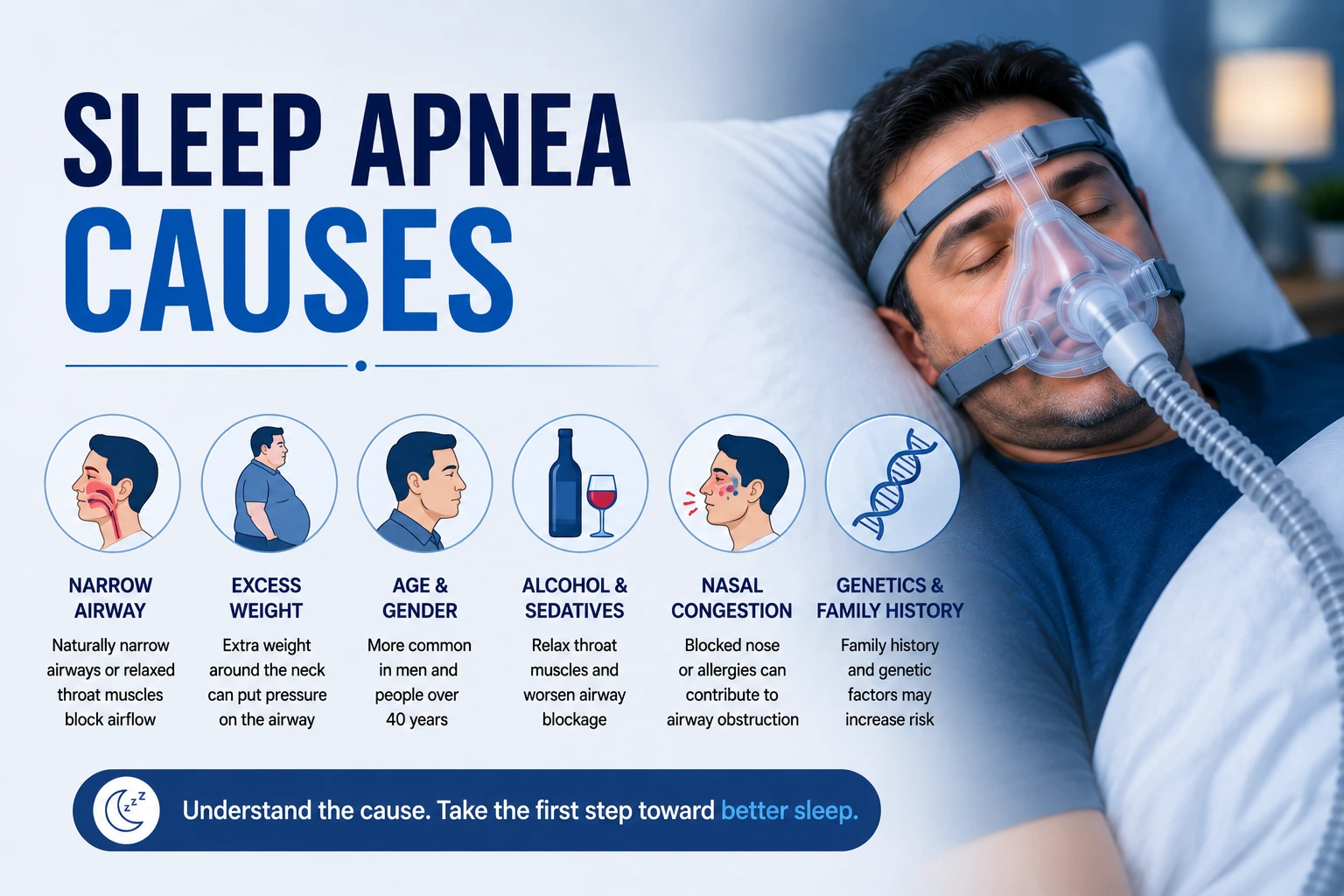
The most direct cause of obstructive sleep apnea is the structure of the airway. Some people are simply built in a way that makes their breathing space narrower than usual during sleep.
A larger-than-average tongue is one factor. When the muscles at the base of the tongue relax during sleep, it can fall back and partially block the throat. This is especially common in people who snore heavily. The sound of snoring is actually air forcing its way past that partial obstruction.
The soft palate matters too. That soft tissue at the back of the roof of the mouth can vibrate or even collapse during sleep, reducing how much air can pass through. A longer uvula that small hanging tissue in the throat can add to the problem.
Some patients have what's called retrognathia, which means the lower jaw sits slightly further back than usual. This naturally reduces the space at the back of the throat. It's something you'd be born with, and in many cases it doesn't cause any obvious problems during the day. But lying flat, with the airway less supported, can make it significant.
Enlarged tonsils or adenoids are another common structural cause. This is particularly important in children with sleep apnea, but adults can be affected too.
None of this means something has gone wrong. It's often just anatomy. But anatomy can be assessed, understood, and managed.
Weight and Its Effect on the Airway
One of the most common and well-established causes of sleep apnea in adults is excess weight particularly around the neck and upper body.
When fat tissue accumulates around the neck, it puts external pressure on the airway. That extra weight compresses the throat from outside. The airway has less room to stay open, especially when the muscles relax during sleep. Research consistently shows that a neck circumference above roughly 40cm in women and 43cm in men is associated with a higher risk of obstructive sleep apnea.
Abdominal weight also plays a role. When you lie down, excess weight around the abdomen pushes upward, reducing how fully the lungs can expand. That affects breathing rhythm throughout the night.
This is one reason sleep apnea often gets worse gradually over the years. Weight tends to increase slowly, so the changes are gradual too. Many patients look back and realise the tiredness crept up on them over a long period.
Losing even a modest amount of weight can make a real difference. It doesn't always resolve sleep apnea completely, but it often reduces its severity and improves how well treatment works.
Why Men Are More Commonly Affected
Sleep apnea affects men at a higher rate than women roughly two to three times more commonly before the age of menopause. The reasons come down to anatomy and hormones.
Men naturally tend to carry more weight around the neck. Their airways are often longer and more prone to collapse under certain conditions. Testosterone may also influence how the upper airway muscles behave during sleep.
That said, sleep apnea in women is frequently underdiagnosed. The symptoms can look different. Women are more likely to report fatigue, mood changes, and difficulty concentrating rather than the loud snoring that often prompts a partner to push someone toward getting checked.
After menopause, the risk in women rises significantly. Oestrogen and progesterone appear to have a protective effect on airway muscle tone. Once those hormone levels drop, that protection reduces. Some studies suggest that post-menopausal women have rates of sleep apnea closer to those seen in men of the same age.
So if you're a woman who's been told sleep apnea is a "man's condition" that's simply not accurate. It's worth getting evaluated.
Age and Why Sleep Changes Over Time
Sleep apnea becomes more common as we age. The muscles throughout the body lose some of their tone over time, and the muscles supporting the airway are no less affected.
Older adults also tend to have less deep, restorative sleep. The structure of sleep itself changes when the body spends more time in lighter sleep stages, which is when the airway is most vulnerable.
This doesn't mean sleep apnea is inevitable with age. But it does explain why many people develop it in their forties, fifties, or later, even without significant weight gain or other obvious risk factors.
Family History and Genetic Factors
Sleep apnea does run in families. If a close family member has been diagnosed, your own risk is higher.
This partly comes down to inherited anatomy: the shape of the jaw, the size of the airway, the position of the tongue base. These structural features tend to be passed down through families. Some people inherit a narrower airway without even realising it.
There also appear to be genetic influences on how the brain controls breathing during sleep, which is relevant to central sleep apnea specifically.
Knowing your family history matters. It's something Dr. Syed asks about during assessments because it helps build a complete picture of each patient's risk.
Central Sleep Apnea: When It's a Brain Signalling Issue
Central sleep apnea is less common than obstructive sleep apnea but important to understand separately. Here, the problem isn't a blocked airway. The airway is clear. But the brain doesn't consistently send the right signals to the muscles that control breathing.
The result is similar to obstructive sleep apnea in terms of what you experience disrupted sleep, fatigue, low oxygen levels during the night but the underlying cause is different.
Central sleep apnea is more commonly seen in people with heart failure, those who have had strokes, or those taking strong opioid pain medications. It can also occur at high altitudes, where reduced oxygen levels disrupt the normal breathing rhythm.
Certain neurological conditions can also play a role. Because the brainstem controls breathing during sleep, any condition that affects the brainstem's function can potentially contribute.
Treatment for central sleep apnea is different from obstructive sleep apnea. Accurate diagnosis matters enormously here. A standard overnight sleep study measures both airflow and breathing effort which is what allows us to distinguish between the two types.
Nasal Congestion and Breathing Route
Chronic nasal blockage is an underappreciated cause of sleep apnea. When the nose is consistently congested whether from allergies, a deviated nasal septum, or chronic rhinitis people unconsciously switch to breathing through the mouth during sleep.
Mouth breathing during sleep changes the position of the tongue and soft palate. It makes airway collapse more likely. It also reduces the natural resistance that nasal breathing provides, which actually helps keep the throat stable.
A lot of patients in Dubai and across the UAE deal with year-round allergic rhinitis, partly due to dust exposure and environmental conditions. It's not always immediately connected to sleep problems, but for some people it's a significant contributing factor.
Managing nasal congestion whether through allergy treatment, nasal sprays, or other means can help improve sleep quality even before other sleep apnea treatments are introduced.
Alcohol, Sedatives, and Sleep Position
Alcohol relaxes muscles. That sounds harmless, but when those muscles include the ones supporting the airway, the effect during sleep is not helpful. Drinking in the evening, even in moderate amounts, can worsen breathing during sleep. The airway relaxes further, collapses more easily, and episodes become more frequent and prolonged.
Sedatives and certain sleep medications have a similar effect. They relax the body's arousal response, which means the brain takes longer to detect and correct breathing interruptions.
Sleep position matters more than many people realise. Sleeping on the back allows the tongue and soft palate to fall backward more easily under gravity. Many patients notice their symptoms are noticeably worse when lying on their back. That simple change sleeping on the side can reduce the number of episodes in some people quite meaningfully.
It doesn't fix the underlying problem, but it can improve symptom severity while other treatments are being established.
Medical Conditions That Contribute to Sleep Apnea
Several medical conditions are strongly associated with sleep apnea. They don't always cause it directly, but they create conditions that make it far more likely.
Hypothyroidism is one. An underactive thyroid can cause weight gain, reduced muscle tone, and fluid accumulation around the airway all of which make sleep-related breathing problems more common. It's one of the conditions Dr. Syed screens for in patients presenting with sleep apnea symptoms.
Type 2 diabetes and insulin resistance are closely linked to sleep apnea partly because of shared risk factors like weight, but also through direct metabolic pathways that affect how the nervous system regulates breathing.
Polycystic ovary syndrome (PCOS) in women increases sleep apnea risk significantly. The hormonal imbalances associated with PCOS, combined with weight-related factors, create a higher-risk profile.
Acromegaly, a rare condition caused by excess growth hormone, causes physical changes to the jaw, tongue, and soft tissues that can directly obstruct the airway.
Heart failure and atrial fibrillation are both associated with sleep apnea, particularly the central type. The relationship runs in both directions; untreated sleep apnea also worsens cardiovascular conditions over time.
Smoking and Its Effect on the Airway
Smokers are significantly more likely to develop sleep apnea than non-smokers. Smoking irritates and inflames the tissues lining the upper airway. It causes swelling and increased mucus production, which narrows the breathing passage.
Nicotine also affects the sleep cycle itself, reducing the amount of deep sleep and increasing the likelihood of waking. The inflammatory changes caused by long-term smoking can persist even after quitting, though stopping smoking still reduces risk over time.
In Dubai, where tobacco use including shisha smoking remains prevalent, this is a relevant point for many patients. Shisha is not a safer alternative. The same airway irritation applies.
How Dr. Syed Evaluates Sleep Apnea Causes
When patients come in with symptoms that suggest sleep apnea, the evaluation is thorough. It's not just about confirming whether sleep apnea is present, it's about understanding why.
Dr. Syed takes a detailed history covering symptoms, weight changes, medical conditions, medications, family history, and lifestyle factors. A physical examination looks at the structure of the airway, the position of the jaw, and the size of the tonsils and soft palate.
When needed, an overnight sleep study is arranged. This can be done at home in many cases it's not as inconvenient as many patients assume. The study measures airflow, breathing effort, oxygen levels, and sleep stages. It gives a clear picture of what's happening and how severe it is.
That information shapes the treatment plan. The cause matters because it determines the approach. A structural cause might be addressed differently from a weight-related or hormone-related one. And sometimes it's several factors together.
Early diagnosis genuinely matters here. The longer sleep apnea goes untreated, the wider its effects on cardiovascular health, cognitive function, and daily wellbeing.
What Treatment Looks Like
Treatment depends on what's driving the condition and how severe it is.
CPAP therapy which uses gentle continuous air pressure to keep the airway open during sleep remains the most widely used and effective treatment for moderate to severe obstructive sleep apnea. Many patients who were resistant to it initially find it manageable once the right device and settings are found.
Custom oral devices can help in milder cases by repositioning the jaw during sleep to maintain an open airway.
Lifestyle changes, weight loss, reducing alcohol intake, changing sleep position are not standalone treatments for most people but they make a real difference to outcomes when combined with other therapies.
In selected cases where a specific structural issue is identified, surgical options may be appropriate.
Central sleep apnea requires a different approach, often involving adaptive pressure devices or treatment of the underlying condition causing the signalling problem.
Nothing here is one-size-fits-all. That's why assessment matters as much as treatment.