Most patients who come in with sleep apnea already suspect weight is part of the story. What surprises them is how direct that connection actually is. Not a vague background factor. A specific, mechanical relationship between fat tissue and the airway that changes what happens every time they fall asleep.
But the relationship goes further than that. Sleep apnea doesn't just worsen because of weight. Untreated sleep apnea also makes weight harder to lose. The two conditions feed each other in a cycle that, without intervention, tends to go in one direction.
Understanding that cycle is the starting point for breaking it.
Why Extra Weight Puts Pressure on the Airway
When we fall asleep, the muscles throughout the body relax. That includes the muscles supporting the throat. In people without sleep apnea, the airway stays open enough for breathing to continue without interruption.
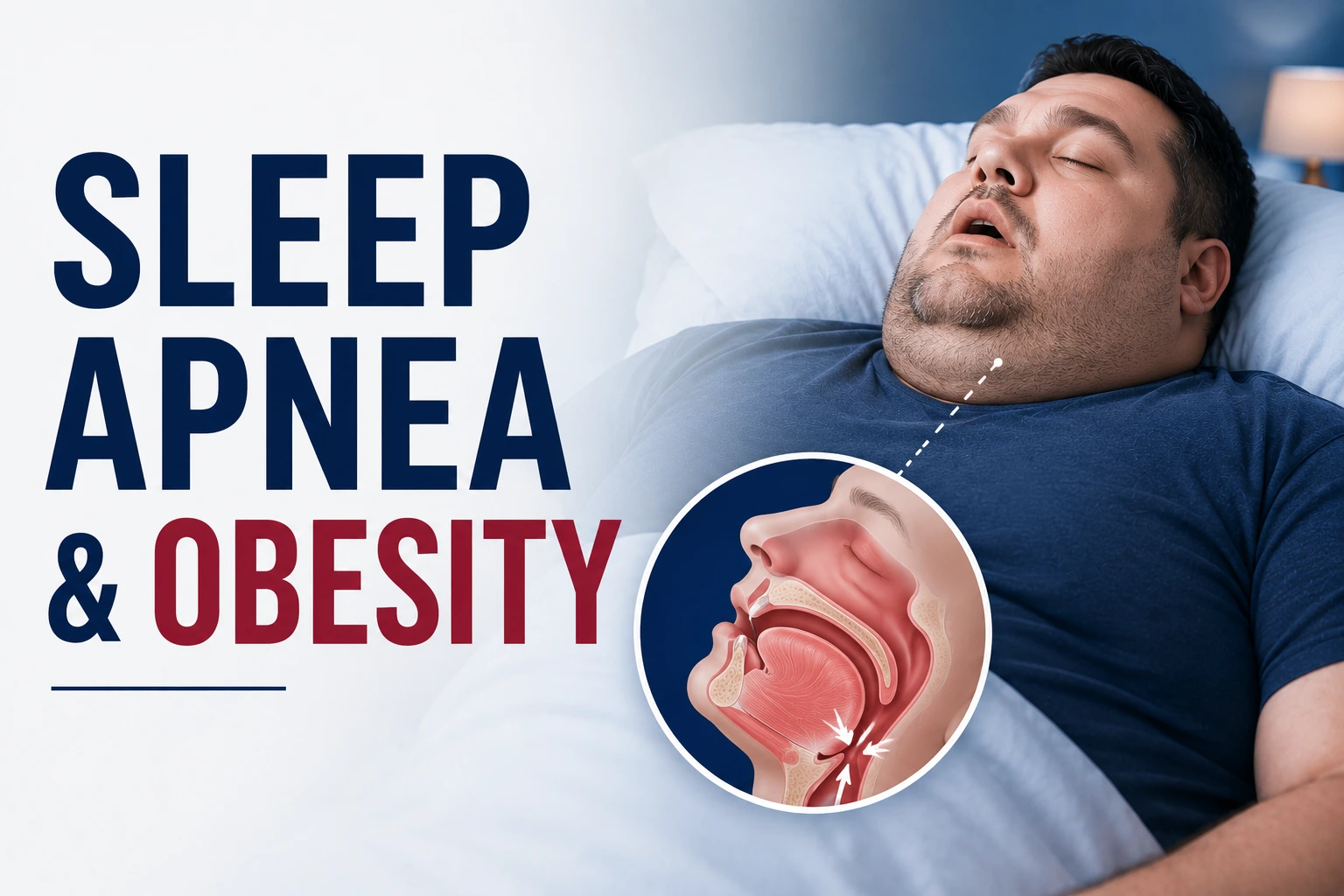
When there's excess fat around the neck and upper body, that tissue puts pressure on the throat from the outside. The airway has less room. The walls are more prone to collapse when the supporting muscles relax. Breathing narrows, slows, or stops.
That's the core physical mechanism. Fat tissue pressing inward on a soft, flexible tube.
Neck size is one of the more reliable physical markers we look at during assessment. A neck circumference above roughly 40 centimetres in women and 43 centimetres in men is associated with meaningfully higher sleep apnea risk. Not because the number itself causes anything, but because it reflects the amount of fat tissue sitting around the airway.
Abdominal fat matters too. When lying down, excess weight around the abdomen pushes upward against the diaphragm. The lungs can't expand as fully. Breathing becomes shallower. The body gets less oxygen with each breath even before any airway collapse occurs.
This is particularly relevant during sleep, when breathing is already slower and the body is less able to compensate.
The Numbers Behind the Link
The relationship between obesity and sleep apnea is one of the strongest in sleep medicine.
Roughly 70 percent of people with obstructive sleep apnea are overweight or obese. Among people who are significantly obese, the majority have some degree of sleep apnea. Studies have consistently found that for every ten percent increase in body weight, sleep apnea risk increases substantially.
That doesn't mean sleep apnea only affects people who are overweight. It doesn't. Thin people develop it too, often because of jaw structure, tongue position, or other anatomical factors. But weight is the most common modifiable risk factor by a considerable margin.
It also means weight loss is one of the most powerful tools available for reducing sleep apnea severity. Not a replacement for treatment. But a genuine, meaningful part of managing the condition.
What Happens Inside When Sleep Apnea Goes Untreated
This is the part of the story that catches people off guard.
Untreated sleep apnea disrupts the hormones that regulate hunger and appetite. Specifically, it raises levels of ghrelin, which drives hunger, and reduces leptin, which signals fullness. The result is an appetite that's harder to manage. People feel hungrier than their calorie intake would justify. Cravings for high-carbohydrate, energy-dense foods increase. Willpower alone doesn't fix a hormonal problem.
At the same time, sleep deprivation slows metabolism. The body becomes more efficient at storing energy rather than burning it. Physical activity feels harder. Motivation drops. Recovery from exercise is slower.
Then there's insulin resistance. Poor sleep disrupts how the body handles glucose. Cells respond less well to insulin. Blood sugar becomes harder to regulate. This promotes fat storage, particularly around the abdomen. And abdominal fat is the type most directly linked to worsening sleep apnea.
So the cycle becomes self-sustaining. Sleep apnea causes poor sleep. Poor sleep drives weight gain. Weight gain worsens sleep apnea. The loop tightens unless something interrupts it.
This is why telling a patient with untreated sleep apnea to simply eat less and move more often doesn't produce the expected results. The physiological environment created by untreated sleep apnea is actively working against them.
Obesity Hypoventilation Syndrome: When It Goes Further
In some patients with significant obesity, sleep apnea progresses to a more serious condition called obesity hypoventilation syndrome.
In this condition, the body doesn't breathe deeply enough during the day or night to maintain normal oxygen and carbon dioxide levels. The weight pressing against the chest wall and diaphragm is significant enough to impair breathing even when awake. Carbon dioxide builds up in the blood over time. Oxygen levels stay persistently low.
Patients often feel very short of breath with minimal effort. Leg swelling is common. Fatigue is severe. Morning headaches are frequent.
This is a more complex condition than standard obstructive sleep apnea and needs careful specialist management. Treatment usually involves more advanced respiratory support than standard CPAP. But the most direct intervention is still weight reduction.
Not everyone with obesity develops this. But it's a real risk in patients with severe obesity and untreated sleep apnea who are left without assessment or support.
Does Losing Weight Actually Improve Sleep Apnea?
Yes. Consistently and meaningfully.
Studies show that even modest weight loss can reduce sleep apnea severity. A ten percent reduction in body weight can produce roughly a thirty percent reduction in apnea frequency. For some patients, particularly those with mild to moderate sleep apnea, significant weight loss can resolve the condition entirely.
For patients with severe sleep apnea, weight loss alone is unlikely to eliminate the need for treatment. But it can reduce how severe it is, improve how well treatment works, and sometimes allow a step down in the intensity of treatment needed.
Bariatric surgery produces the most dramatic results. Studies of patients who underwent weight loss surgery show substantial reductions in sleep apnea severity, with a significant proportion achieving full resolution. This isn't a straightforward option for everyone and carries its own considerations. But for patients with severe obesity where other weight loss approaches haven't worked, it's a genuine option worth discussing with the relevant specialists.
What this means practically is that weight management is not a side note in sleep apnea care. It's a central part of it.
Why Treatment Still Matters While Working on Weight
A common question is whether to start CPAP or other treatment while also working on weight loss, or to try weight loss first and see if that resolves things.
The answer, in most cases, is to treat the sleep apnea while working on weight. Not one or the other.
Here's why. Untreated sleep apnea actively undermines weight loss. The hormonal disruption, the fatigue, the insulin resistance, the reduced capacity for physical activity — all of these are driven by poor sleep. Treating sleep apnea first creates the physiological conditions where weight loss efforts are more likely to succeed.
Patients who start CPAP therapy often find that energy returns, appetite regulation improves, and physical activity becomes more achievable. The weight loss efforts that felt futile before started producing results.
CPAP doesn't cause weight loss directly. But it removes a major obstacle that was preventing progress.
Practical Steps That Make a Real Difference
Weight loss, for most people, comes down to sustained lifestyle changes rather than any single intervention. A few things are worth knowing specifically in the context of sleep apnea.
Alcohol is worth cutting back on, particularly in the evenings. Alcohol relaxes the muscles of the throat further than sleep alone does. Even moderate drinking before bed can noticeably worsen sleep apnea severity. It also adds calories and disrupts sleep architecture, working against the goals of weight management.
Physical activity helps in two ways. It supports weight loss directly. But it also improves sleep quality independently of weight changes. Regular aerobic exercise has been shown to reduce sleep apnea severity even without significant changes in body weight. Exercise doesn't need to be intense to be useful here. Consistent, moderate activity produces real benefit.
Sleep position matters too. Sleeping on the side rather than the back reduces the tendency for the tongue and soft tissue to fall backward into the airway. It doesn't resolve the underlying cause, but it reduces nightly severity and is a simple, immediate change.
Meal timing can help as well. Eating large meals late at night increases abdominal pressure when lying down and can worsen breathing during sleep. Lighter evening meals and avoiding eating close to bedtime is a practical adjustment many patients find makes a difference.
None of these replace medical treatment. But they work alongside it.
How Assessment Works
When patients come to Dr. Syed Arshad Husain at Al Zahra Hospital in Dubai, the consultation covers the full picture.
Symptoms are explored in detail. How tired they feel, how long that's been the case, what sleep quality has been like, whether a bed partner has noticed snoring or pauses in breathing. Weight history is reviewed. How long weight has been a challenge, whether it's increased over the period that sleep problems developed, what's been tried before.
Physical assessment includes neck circumference, body weight relative to height, and examination of the airway structure. Medical history covers blood pressure, blood sugar, thyroid function, and any other conditions that interact with sleep apnea and weight.
A home sleep study is arranged when indicated. It records what's happening to breathing and oxygen levels through the night. Results are reviewed in context of the full clinical picture, not in isolation.
Treatment planning covers both the sleep apnea itself and the contributing factors. For most patients with moderate to severe obstructive sleep apnea, CPAP therapy is started. Weight management support is discussed, whether that involves dietary advice, referral, or coordination with other specialists. Follow-up is arranged to review both sleep and weight progress together.
What to Expect Going Forward
Managing sleep apnea when weight is a factor is not a short-term project. It requires consistency. But progress is achievable and the improvements compound over time.
Starting CPAP often produces quick changes in energy and alertness. That's a foundation. Better sleep makes it easier to be active, easier to make good food choices, and easier to manage the stress that often drives poor habits.
Weight loss, even gradual, reduces sleep apnea severity. As severity reduces, treatment becomes more effective and more comfortable. Some patients reach a point where their sleep apnea is mild enough to be managed with lifestyle alone. For others, ongoing treatment remains appropriate, but at reduced intensity.
The goal is a sustainable improvement in sleep quality, cardiovascular health, metabolic function, and daily energy. Not a perfect outcome overnight. A better trajectory.
That's what treating both conditions together produces.