When someone mentions sleep apnea treatment, what springs to mind is a mask and machine making loud noises. But treatment for sleep apnea with the use of oral appliances provides something entirely different.
Unlike a CPAP machine, which uses air pressure to keep your air passages open, an oral appliance works on the principle of positioning. This is a customized piece of equipment that is designed to be worn in your mouth while sleeping. The design and appearance of an oral appliance are quite similar to a mouth guard that athletes use or an orthodontic retainer. It physically holds your jaw or tongue in place to keep your air passages from closing by keeping your throat muscles from collapsing.
Picture this: Finally, you have a correct diagnosis for your chronic fatigue. Your physician informs you that you stop breathing multiple times per hour and prescribes you a CPAP device. After bringing the device home and putting the mask on your face, turning on the air pressure and... hating everything about it. You get claustrophobic, the hose entangles itself as soon as you change your position, and the sound disturbs your partner's sleep.
You keep trying for many weeks but cannot get used to it. And finally, you throw the machine away into the darkest corner of your room letting it gather dust, and return to waking up tired every morning.
If this sounds familiar, then you are far from being an exception. About half of all patients prescribed CPAPs give up on using the devices during the first year after purchase. However, leaving a condition untreated is unacceptable in terms of your future health condition. Therefore, what could be your Plan B? Here is where oral appliances come into play.
How an Oral Appliance for Sleep Apnea Actually Works
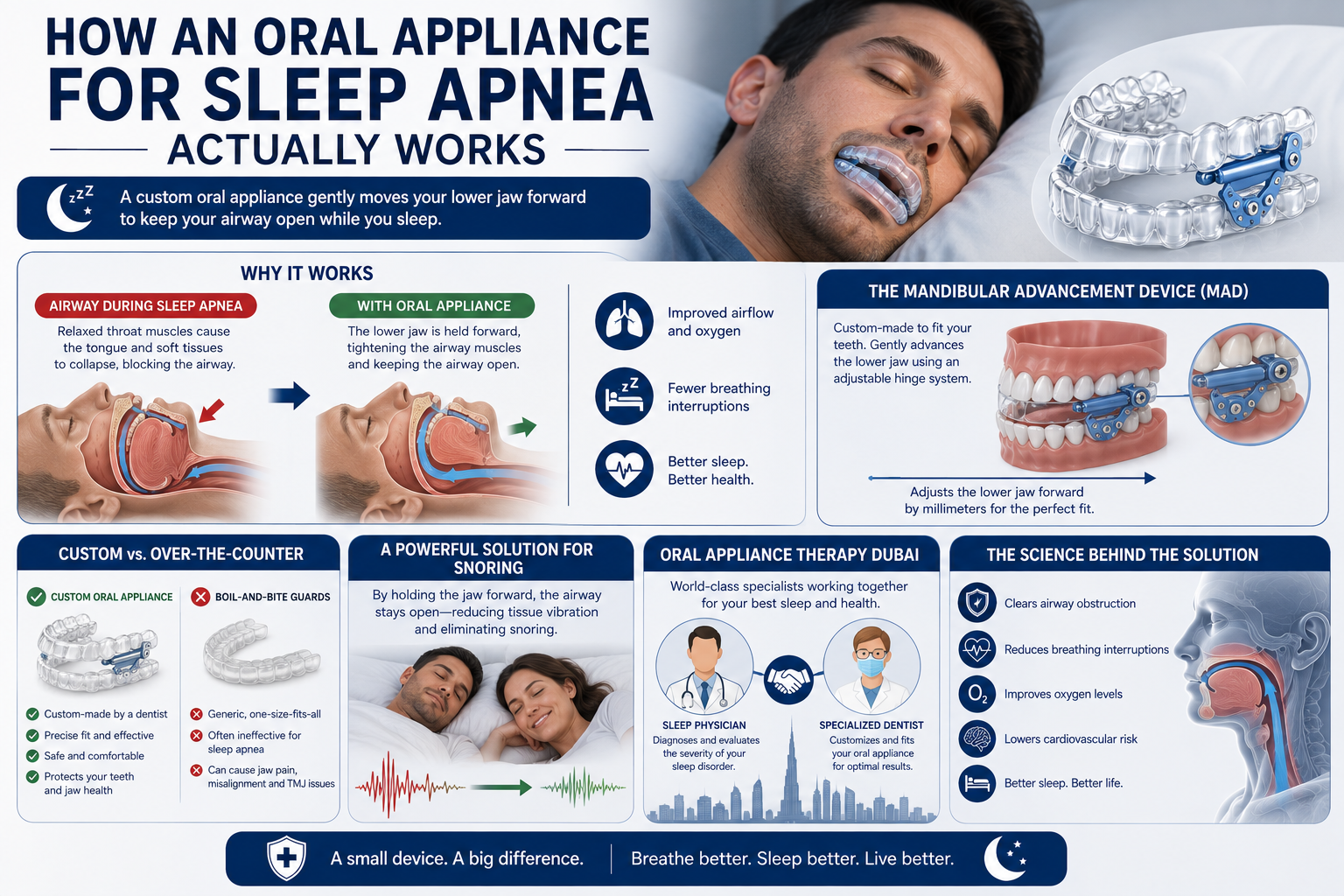
It is important to understand how this kind of sleep apnea occurs before explaining why this oral device works well against the disorder. When you go to sleep, all your body muscles are relaxed. In the case of sleep apnea, even the muscles at the back of the throat tend to relax too much. The tongue moves to the back, and the soft tissues collapse. This makes it difficult to breathe because the airway is closed.
The oral device helps with this particular problem by holding the mandible slightly forward. This will tighten the soft tissues and muscles of the airway. With the slight forward pulling, the airway can be kept open to allow air passage into the lungs. Thus, your body will be getting the required oxygen without going through any panic situation.
Exploring the Specifics
Not all mouthpieces are created equal. If you are exploring this route, you will run into a few specific terms that you need to know.
The Mandibular Advancement Device (MAD)
And here we have the ultimate gold standard in terms of oral appliances. The mandibular advancement device will be individually molded based on your dental impressions. "Mandibular" indicates that the appliance is used on your lower jaw, while "advancement" indicates that it is pushed forward. The appliance is made to cover both your upper and lower teeth and has a little hinge or adjusting system. This adjusting system is adjusted by a specialist in order to move your lower jaw forward by the required number of millimeters.
The Sleep Apnea Mouth Guard vs. Over-the-Counter Options
You might see advertisements for a cheap sleep apnea mouth guard that you can buy online and boil at home to fit your teeth. A massive word of caution here: these are rarely effective for true medical sleep apnea. A boil-and-bite guard might offer temporary relief, but it lacks the precision needed to keep the airway consistently open. Worse, an improperly fitted guard can cause severe jaw pain, shift your teeth out of alignment, and lead to TMJ (temporomandibular joint) disorders. A true clinical mouth guard must be custom-made by a specialized dentist working in tandem with a sleep physician.
A Highly Effective Dental Device for Snoring
Even if you don't have full-blown apnea, these appliances work wonders for heavy snorers. Snoring happens when the airway is partially blocked, causing the tissues to vibrate as air squeezes past. A dental device for snoring uses the exact same jaw-advancing mechanism to widen the airway, stopping the vibration and silencing the snoring immediately. Your partner will thank you.
Seeking Oral Appliance Therapy Dubai
The key to success with these devices is expert fitting and follow-up. If you are looking for top-tier oral appliance therapy Dubai has world-class specialists who collaborate to treat respiratory issues. Treating sleep-disordered breathing requires a dual approach: a sleep physician to diagnose the severity of the airway collapse, and a specialized dentist to craft the physical device.
The Science Behind the Solution
Let's look at the broader medical context of why this treatment is gaining so much traction.
For decades, the medical community viewed CPAP as the only real answer for obstructive sleep apnea. But as patient compliance rates dropped, the need for a viable CPAP alternative became urgent. Oral appliances stepped into that void perfectly. Clinical studies now show that for patients with mild to moderate apnea, custom oral appliances are nearly as effective as CPAP machines at reducing the Apnea-Hypopnea Index (the number of times you stop breathing per hour).
The primary goal is resolving the airway obstruction. When that obstruction is cleared, the loud, disruptive snoring stops, and more importantly, the cardiovascular strain halts. Untreated apnea causes blood pressure to spike wildly during the night, vastly increasing the risk of heart attacks and strokes. By utilizing a physical splint to keep the throat open, oral appliances mitigate these dangerous health risks without tying the patient to an electronic machine.
Finding the Right Expert for Your Care
It is not possible for anyone to visit a common dental hospital and request for an apnea device without undergoing a complete medical assessment first. It is necessary to undergo a comprehensive evaluation of the respiratory system to see whether or not the patient's particular form of airway collapse can be managed through oral treatment.
In case you have to make these choices in the UAE, it is essential to consult one of the leading pulmonologists first. One of the leading pulmonologists in the country is Prof. Dr. Syed Arshad Husain who currently practices at Al Zahra Hospital Dubai. He has more than 30 years of experience in the NHS of the United Kingdom.
Specialists like Dr. Husain don’t just hand out one-size-fits-all treatments. They look at your comprehensive sleep study data, evaluate your oxygen saturation drops, and determine whether a CPAP, a BiPAP, or a custom oral appliance is the safest and most effective route for your specific anatomy. If an oral appliance is the right choice, a physician of this caliber will coordinate with specialized dental professionals to ensure your device is crafted perfectly, effectively turning the tide on your sleep deprivation.