Can Obstructive Sleep Apnea Cause High Blood Pressure and Pulmonary Hypertension?
Blood pressure that won't settle despite medication is one of the more common reasons a patient ends up in a sleep clinic rather than a cardiology clinic. The connection between obstructive sleep apnea and hypertension is well documented, and it runs in a direction most people don't expect: what happens in the airway at night shows up on the blood pressure cuff by day.
Can obstructive sleep apnea cause high blood pressure? Obstructive sleep apnea is strongly associated with hypertension. The American Heart Association's 2021 scientific statement reports OSA prevalence as high as 40% to 80% in patients with hypertension, heart failure, coronary artery disease, pulmonary hypertension, atrial fibrillation and stroke, and recommends screening for OSA in patients with resistant or poorly controlled hypertension.
Why You Can Trust This Guide
This article draws on the American Heart Association's scientific statement Obstructive Sleep Apnea and Cardiovascular Disease (Circulation, 2021) and the American Academy of Sleep Medicine's clinical practice guidelines. It reflects those documents, not individual patient records.
Where clinical opinion genuinely differs — notably on how far treating OSA changes long-term cardiovascular outcomes, as opposed to the association between the two — that disagreement is stated rather than flattened.
What the airway does to the circulation
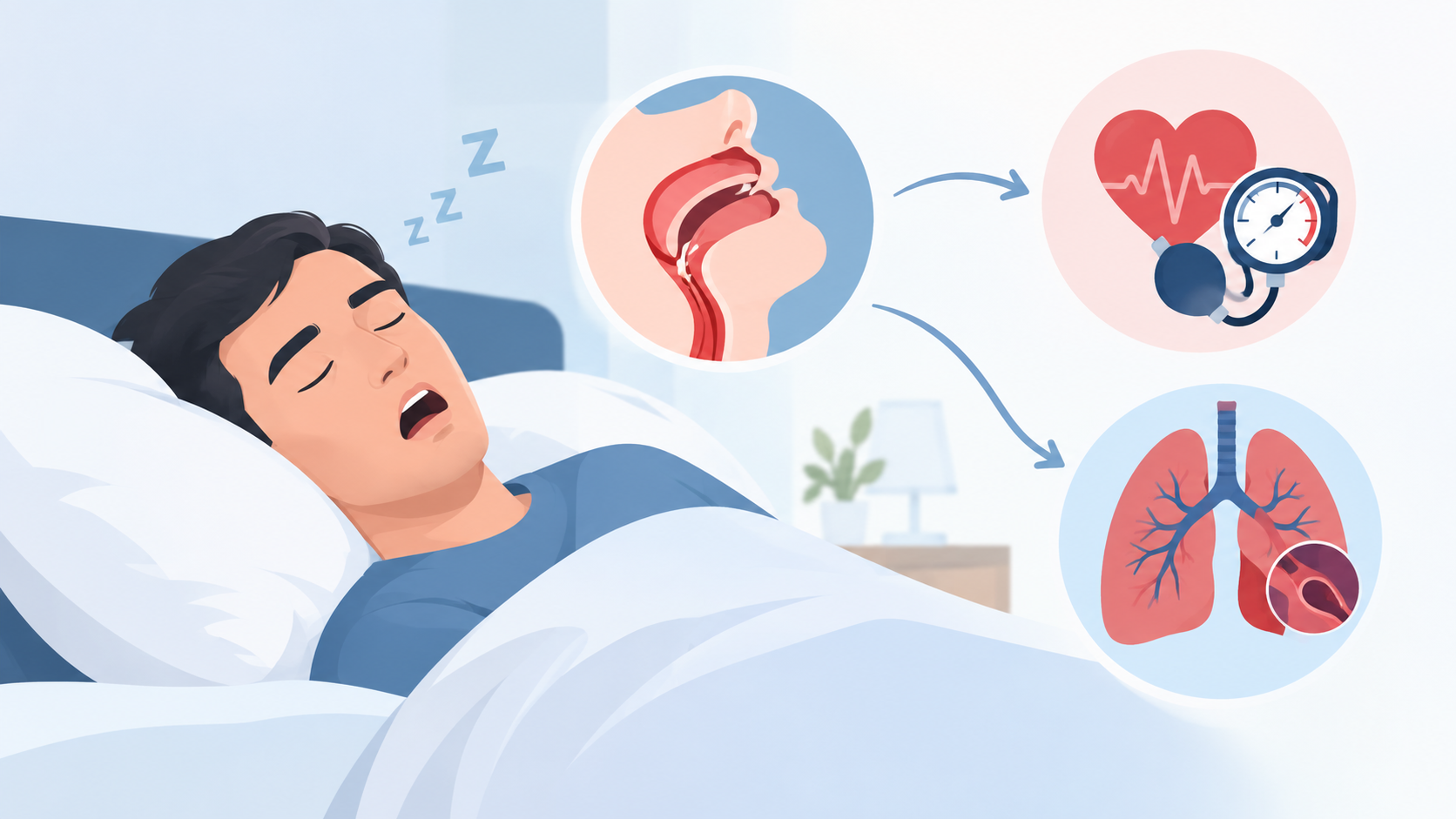
OSA involves repeated complete and partial obstruction of the upper airway, producing intermittent hypoxemia, autonomic fluctuation and sleep fragmentation. Each obstructive event is a physiological stressor: oxygen falls, the body responds, and the cycle repeats — often hundreds of times a night.
Three mechanisms link that pattern to blood pressure:
- Sympathetic activation. Repeated arousal and oxygen desaturation drive sympathetic nervous system activity, which raises vascular tone.
- Intermittent hypoxia. Cycles of falling and restoring oxygen affect vascular function over time, rather than in a single night.
- Intrathoracic pressure swings. Breathing hard against a closed airway changes pressures inside the chest, loading the heart.
The result is that blood pressure does not drop overnight the way it should in an untreated patient.
Pulmonary hypertension: a different question
Pulmonary hypertension is raised pressure in the arteries of the lungs, not the systemic arteries a cuff measures. The AHA statement lists pulmonary hypertension among the conditions in which OSA prevalence runs between 40% and 80%, and it recommends OSA screening in patients with pulmonary hypertension.
The association is established. The degree to which OSA alone causes pulmonary hypertension, versus coexisting with shared risk factors such as obesity and lung disease, is a more contested question and one your specialist will assess individually.
Should someone with resistant hypertension be tested for sleep apnea? The American Heart Association recommends screening for obstructive sleep apnea in patients with resistant or poorly controlled hypertension, pulmonary hypertension, and recurrent atrial fibrillation following cardioversion or ablation. Screening means a formal sleep assessment, since OSA cannot be confirmed or excluded on symptoms alone.
What diagnosis actually involves
Diagnostic testing is carried out by overnight in-laboratory polysomnography or by home sleep apnea testing. Diagnosis requires reported nocturnal breathing disturbance — snoring, snorting, gasping or pauses — or daytime sleepiness unexplained by other conditions, together with an apnea-hypopnea index or respiratory event index of 5 or more.
Table — What OSA is associated with
| Cardiovascular condition | AHA-reported OSA prevalence in that group |
|---|---|
| Hypertension | 40–80% |
| Heart failure | 40–80% |
| Coronary artery disease | 40–80% |
| Pulmonary hypertension | 40–80% |
| Atrial fibrillation | 40–80% |
| Stroke | 40–80% |
Source: American Heart Association scientific statement, Circulation, 2021. These are prevalence figures within cardiovascular patient groups, not risk of developing disease.
See a doctor promptly if you have
- Witnessed pauses in breathing during sleep, or waking gasping or choking
- Blood pressure that stays high despite three or more medications
- Morning headaches with daytime sleepiness
- Falling asleep while driving or at work
- Irregular heartbeat, chest discomfort or ankle swelling alongside disrupted sleep
Any of these warrants medical assessment rather than watchful waiting.
Takeaways
- OSA is highly prevalent among patients with hypertension and other cardiovascular conditions
- The mechanisms are sympathetic activation, intermittent hypoxia and intrathoracic pressure swings
- The AHA recommends OSA screening in resistant hypertension and pulmonary hypertension
- Diagnosis requires a sleep study — symptoms alone are not enough
- Pulmonary hypertension and OSA are associated; causation is less settled
Book a pulmonology consultation with Prof. Dr. Syed Arshad Husain at Al Zahra Hospital Dubai — call +971 54 384 4156.