When we talk about surgery for sleep apnea, we are generally talking about procedures designed to widen your breathing passages.
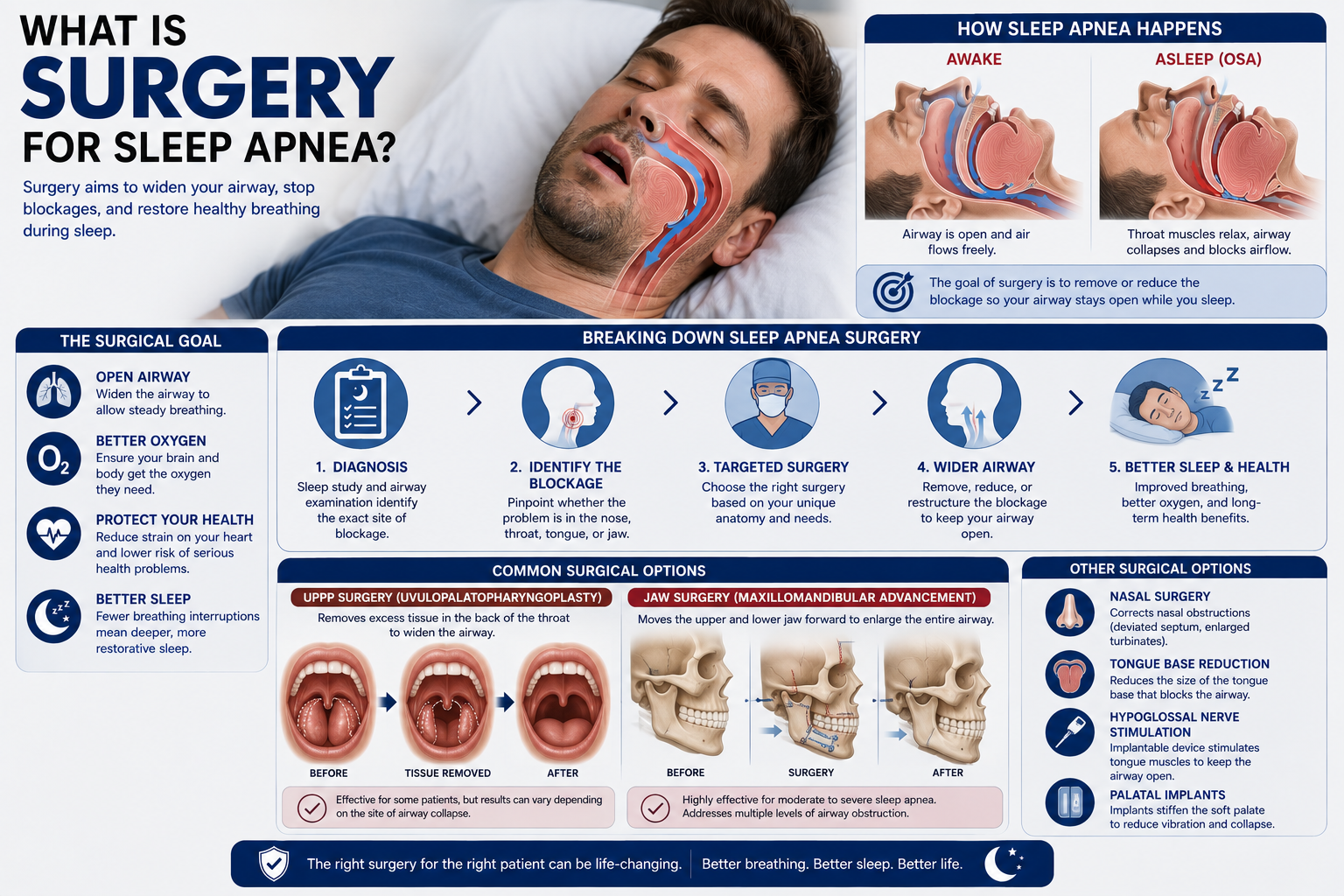
Obstructive sleep apnea (OSA) happens because the soft tissues in your throat relax too much during sleep. Gravity takes over, the tissues collapse, and your airway is physically blocked. Surgery aims to remove or shrink those blocking tissues, or in some cases, restructure the bones of your face to create a permanently larger airway.
The goal of these surgeries isn't just to stop you from snoring (though that is a nice bonus). The medical goal is to drastically reduce your Apnea-Hypopnea Index (AHI)—the number of times you stop breathing per hour—so your brain gets steady oxygen and your heart stops working overtime while you sleep.
Breaking Down Sleep Apnea Surgery
Not all sleep apnea surgery is created equal. The type of surgery a doctor recommends depends entirely on your specific anatomy. If the blockage is happening in your nose, a throat surgery won't help you. If your jaw is the problem, removing your tonsils won't cure the apnea.
This is why proper diagnosis by a pulmonary or ENT (Ear, Nose, and Throat) specialist is so critical. They use tools like sleep studies and physical airway examinations to pinpoint the exact site of the collapse. Once the "choke point" is identified, they can recommend a targeted surgical intervention.
Exploring the Specifics
Let’s look at the most common surgical options, ranging from soft tissue removal to major skeletal adjustments.
UPPP Surgery (Uvulopalatopharyngoplasty)
Try saying that three times fast. Historically, UPPP surgery was the most common surgical approach for sleep apnea. It involves removing excess tissue from the back of the throat. The surgeon will typically remove the uvula (the little punching bag hanging at the back of your throat), parts of the soft palate, and the tonsils if you still have them.
The idea is to widen the airway by clearing out the clutter. While this sounds logical, the results for UPPP have historically been mixed. It works very well for some carefully selected patients, but for others, the airway simply collapses lower down in the throat, meaning the apnea persists even after a painful recovery.
Jaw Surgery for Sleep Apnea
If the issue isn't just soft tissue, surgeons have to look at the bone structure. Jaw surgery for sleep apnea, medically known as Maxillomandibular Advancement (MMA), is a highly effective, albeit intense, procedure.
During an MMA, the surgeon cuts the bones of your upper and lower jaw and physically moves them forward. This pulls the tongue and the soft tissues of the palate forward as well, permanently enlarging the entire airway space. Because it addresses multiple levels of obstruction simultaneously, MMA boasts a very high success rate, often significantly improving or even curing severe sleep apnea. However, it is a major surgery with a long recovery time, and it changes the physical appearance of the patient's face.
Is Sleep Apnea Surgery Effective?
So, is sleep apnea surgery effective? The answer is: it depends entirely on patient selection. Surgery is highly effective when a specific, correctable structural problem is driving the apnea. For example, if a patient has massive, chronically enlarged tonsils that are clearly blocking the throat, a simple tonsillectomy can produce incredible results. If a recessed jaw is the obvious culprit, MMA surgery is highly effective. But if the apnea is caused by general obesity or lack of muscle tone in the throat, traditional soft tissue surgeries are much less likely to provide a permanent cure.
Seeking Sleep Apnea Surgery Dubai
If you are exploring these advanced options, finding the right medical team is paramount. For patients seeking sleep apnea surgery Dubai offers access to world-class specialists who take a multidisciplinary approach.
For instance, you shouldn't just consult a surgeon; you need a comprehensive respiratory evaluation first. Prof. Dr. Syed Arshad Husain, a highly respected pulmonologist practicing at Al Zahra Hospital Dubai, frequently evaluates patients to determine the root cause of their apnea. With over 30 years of experience (including extensive time with the UK’s NHS), Dr. Husain utilizes advanced diagnostics—like comprehensive sleep studies—to identify exactly why a patient is struggling. He can then guide patients toward the most effective treatment, whether that is finding a better CPAP alternative, utilizing advanced devices, or referring them to a specialized surgeon for structural correction.
The Broader Context of Airway Obstruction
When dealing with severe obstructive sleep apnea, surgery is rarely the first step. Medical guidelines typically require patients to attempt CPAP therapy, weight loss, or oral appliances before considering invasive procedures.
However, surgery is sometimes used as a facilitator rather than a cure. For example, some patients cannot tolerate a CPAP machine because they have a severely deviated septum that blocks airflow through their nose. In this case, an ENT specialist might perform nasal surgery (septoplasty) to clear the nasal passage. The nasal surgery alone might not cure the sleep apnea, but it clears the airway obstruction just enough to make CPAP therapy comfortable and effective.
It is also worth noting that surgical options are evolving. One of the newer alternatives is Hypoglossal Nerve Stimulation (often known by the brand name Inspire). Instead of removing tissue or cutting bone, a small device is implanted in the chest (similar to a pacemaker). When it senses you taking a breath, it sends a mild electrical pulse to the nerve that controls your tongue, pushing the tongue forward and keeping the airway open.