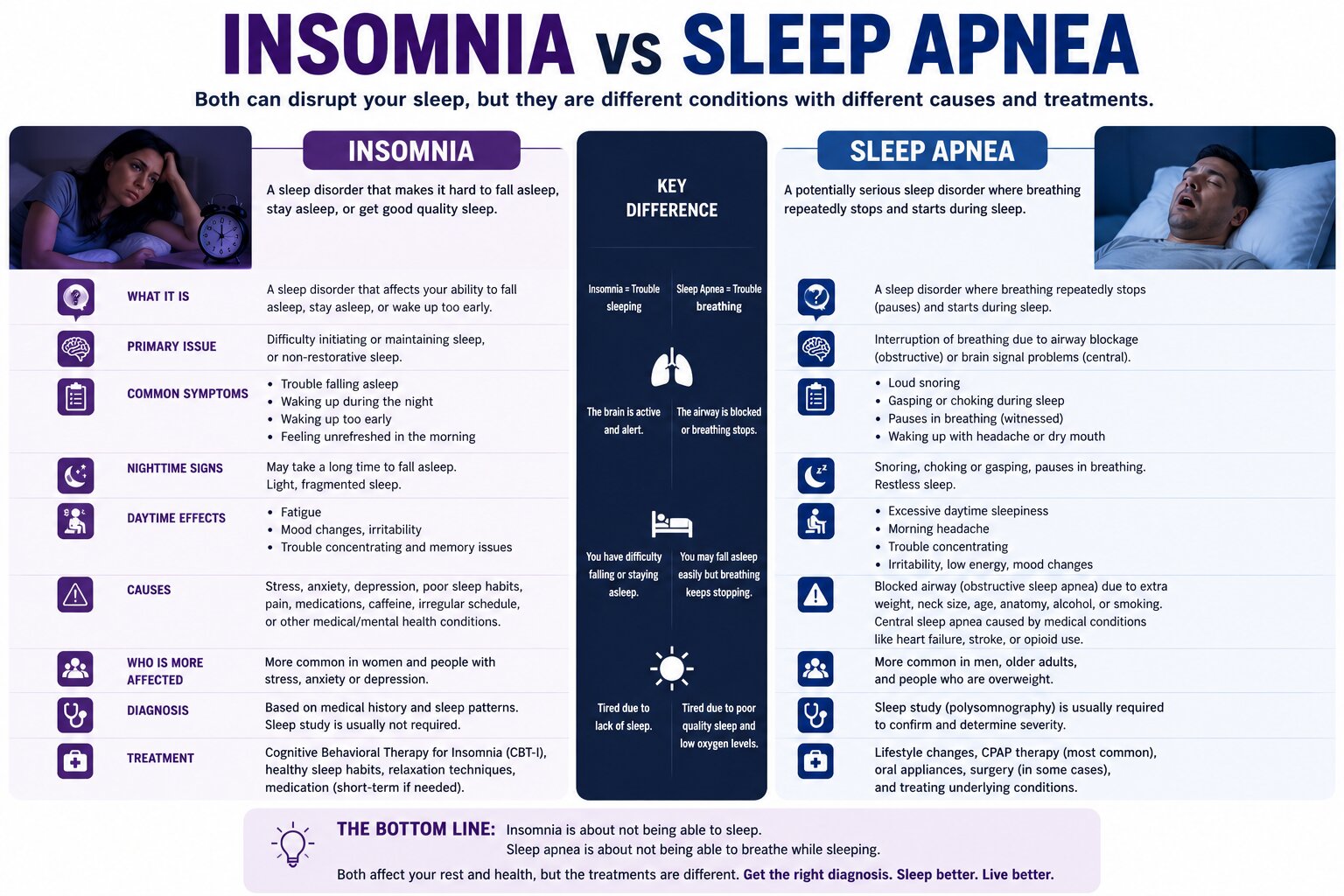
Insomnia and sleep apnea are both sleep disorders, but they work in completely different ways and need different treatment. Insomnia is a problem with the ability to fall or stay asleep. Sleep apnea is a problem with breathing during sleep that disrupts rest without the person necessarily realising it. The two can look similar from the outside both leave people exhausted and struggling to function but treating one when the other is actually present won't work. And using the wrong treatment can sometimes make things worse.
What Insomnia Actually Is
Insomnia means difficulty getting to sleep, staying asleep, or waking too early and not being able to return to sleep at least three nights a week, for at least three months, in the case of chronic insomnia.
The person is usually aware of the problem. They lie awake. They watch the clock. They feel frustrated. They worry about not sleeping, which makes sleeping harder. The brain becomes hyperalert at night, associated with a state of heightened arousal that's incompatible with restful sleep.
During the day, insomnia produces fatigue, difficulty concentrating, irritability, and low mood. Sound familiar? It overlaps considerably with sleep apnea on the surface.
But the mechanism is different. In insomnia, the problem is the brain's wakefulness system being too active at night. There's nothing wrong with how the person breathes during sleep.
What Sleep Apnea Actually Is
Sleep apnea causes repeated breathing interruptions during sleep. The airway narrows or closes. Breathing stops. Oxygen drops. The brain briefly rouses the body to restore breathing. Then the cycle repeats.
In obstructive sleep apnea, which is the most common type, this happens because the throat muscles relax too far. In central sleep apnea, the brain doesn't reliably send the signal to breathe.
Here's what makes it different from insomnia. Many people with sleep apnea have no problem falling asleep. They fall asleep quickly. They sleep for what looks like a full night. And they wake exhausted anyway. Because the breathing disrupts fragment sleep so thoroughly that restorative sleep never properly occurs.
The person often has no memory of waking. Their partner might notice gasping, loud snoring, or pauses in breathing. But the patient just knows they feel drained every morning, regardless of how many hours they were in bed.
When Both Are Present: COMISA
COMISA stands for comorbid insomnia and sleep apnea. It's not rare. A meaningful proportion of people with sleep apnea also have clinical insomnia, and the combination tends to produce worse outcomes than either condition alone.
The relationship between the two can go in several directions. Sleep apnea disrupts sleep enough to trigger conditioned arousal and sleep anxiety essentially, the repeated awakenings create a secondary insomnia that then persists even if the sleep apnea is treated. On the other hand, the hyperarousal of insomnia may make someone more sensitive to the brief arousals from sleep apnea events, waking more completely than they otherwise would.
In COMISA, treating only the sleep apnea with CPAP often doesn't fully resolve the insomnia component. The person uses their device, breathing improves, but they still can't sleep well. This is because insomnia has developed its own independent pattern that needs its own treatment.
Current sleep medicine guidance recommends that both conditions be identified and treated, often sequentially or together. Cognitive behavioural therapy for insomnia, known as CBT-I, is the recommended first-line approach for insomnia. It addresses the thought patterns and behaviours that maintain poor sleep. CPAP addresses the breathing component. In COMISA, both may be needed.
The Risk of Sleeping Pills When Sleep Apnea Is Present
This is a clinically significant issue that doesn't get discussed enough.
Standard sleeping tablets, particularly older benzodiazepine-type medications, relax muscles and suppress the brain's arousal response. In someone without sleep apnea, this helps them sleep. In someone with obstructive sleep apnea, it makes things considerably worse. The throat muscles relax further, the airway collapses more easily, and the brain's ability to rouse the body to correct a breathing pause is blunted. Apnea episodes become longer and more severe.
Some newer sleep medications have a somewhat different mechanism and may carry less of this risk, but caution is still warranted in anyone with untreated or undiagnosed sleep apnea.
This is one reason why ruling out sleep apnea before treating insomnia with medication matters. Prescribing a sleeping tablet to someone who actually has sleep apnea can worsen a serious health condition. It's not a theoretical risk.
CBT-I, by contrast, is safe regardless of whether sleep apnea is present. It doesn't suppress breathing or muscle tone. It's worth considering as the first approach to insomnia specifically because it doesn't carry this interaction risk.
How the Two Conditions Are Distinguished
A detailed clinical assessment is the starting point. The history covers what exactly is happening during the night, whether falling asleep is the problem, whether staying asleep is the problem, whether the person wakes tired despite apparently sleeping, whether snoring or breathing pauses have been noticed, and what daytime functioning looks like.
Questionnaires help. The Epworth Sleepiness Scale measures daytime sleepiness. Insomnia severity scales measure the specific insomnia symptoms. Sleep diaries over one to two weeks show the pattern of sleep more clearly than memory alone.
A sleep study is the definitive tool for sleep apnea. It records airflow, breathing effort, oxygen levels, and heart rate through the night. It shows whether breathing is being disrupted and how severely. A normal sleep study in a person with sleep symptoms points away from sleep apnea and toward insomnia or another cause.
Where both seem likely based on the clinical picture, assessment is designed to capture both. Insomnia questionnaires alongside sleep apnea screening tools, with a sleep study to confirm or exclude breathing disruption.
Dr. Syed Arshad Husain at Al Zahra Hospital in Dubai, the assessment covers both possibilities from the outset. The aim is not to assume one diagnosis but to understand what's actually happening before any treatment is recommended.
Key Takeaways
- Insomnia is a disorder of the ability to sleep. Sleep apnea is a disorder of breathing during sleep. They feel similar from the outside but work differently.
- Both cause fatigue, poor concentration, and mood difficulties. Morning headaches are more specific to sleep apnea. Lying awake worrying is more specific to insomnia.
- COMISA means having both at the same time. It's more common than expected and needs both conditions addressed.
- Sleeping pills can worsen sleep apnea by relaxing throat muscles and suppressing the brain's arousal response. Ruling out sleep apnea before prescribing sleep medication matters.
- CBT-I is the recommended treatment for insomnia. CPAP is the standard treatment for moderate to severe obstructive sleep apnea. In COMISA, both may be needed.
- A sleep study distinguishes between the two. Getting the diagnosis right determines whether treatment will work.
Conclusion
Insomnia and sleep apnea are different conditions that require different approaches. They can coexist, and when they do, both need to be addressed. Getting a clear diagnosis before starting treatment avoids the frustration of months of the wrong therapy for the wrong condition.
If you're not sure whether what you're experiencing is insomnia, sleep apnea, or both, a proper sleep assessment is the most direct route to an answer.
Dr. Syed Arshad Husain consults at Al Zahra Hospital, Dubai, with extensive experience in sleep medicine and respiratory conditions. To book a sleep assessment, call +971 04 378 6666.