
Why Sleep Requirements Change With Age
Sleep is not a fixed biological constant. The brain and body have very different needs at different stages of development and aging. An infant's brain is growing at a rate that requires enormous amounts of sleep to support it. A teenager's body is going through changes that genuinely shift sleep timing and duration needs. An older adult's sleep architecture changes in ways that affect how restorative each hour actually is.
These are not preferences. They are physiological realities shaped by brain development, hormonal cycles, circadian rhythm changes, and the repair demands placed on the body at each life stage.
Sleep Requirements by Age Group
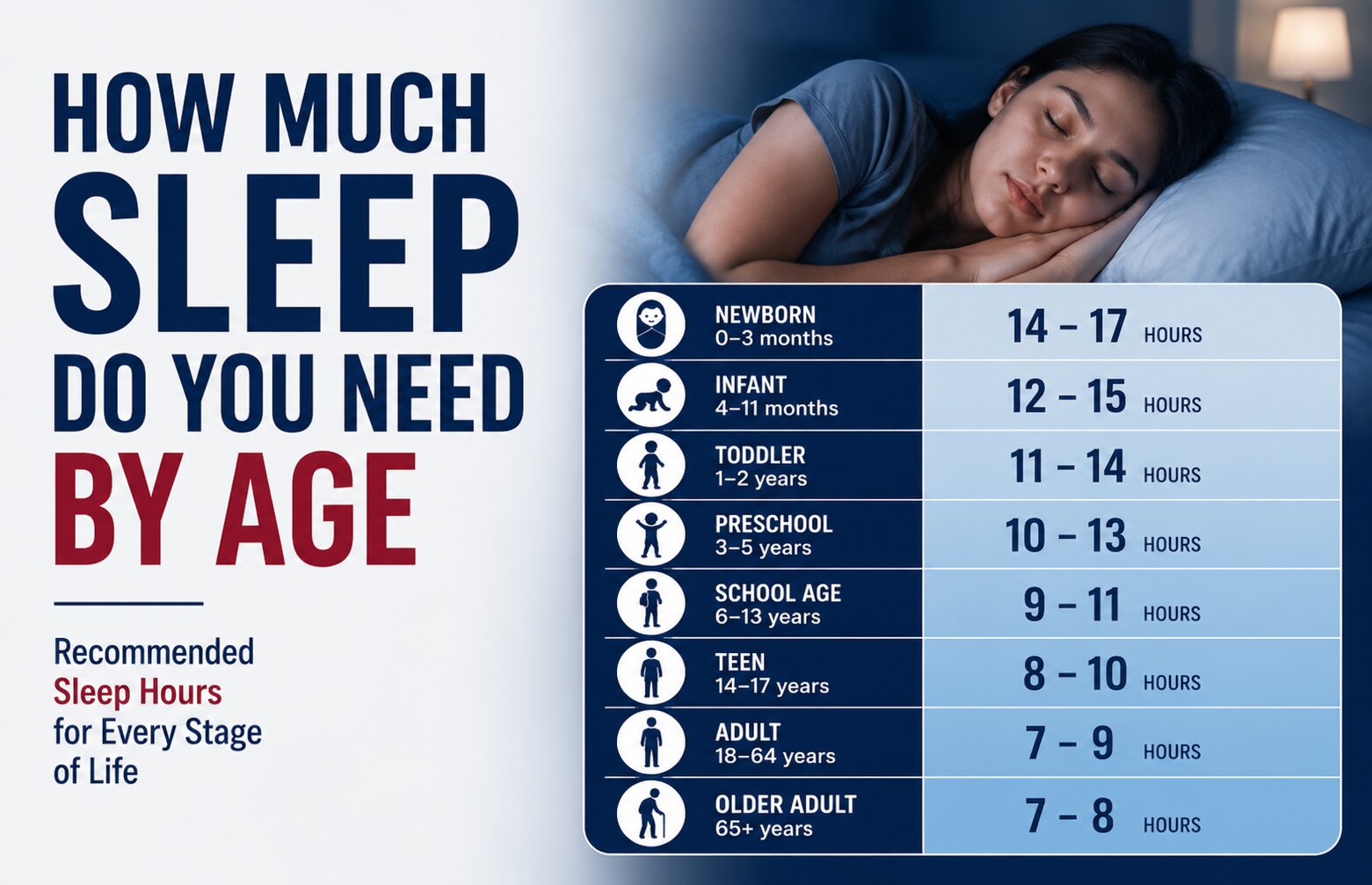
Newborns (0–3 months) 14 to 17 hours
Newborns sleep more than they are awake. Their brains are developing at a rate that demands sustained sleep to support it. Sleep occurs in multiple short periods across the day and night; this is normal and developmentally appropriate. REM sleep accounts for a much higher proportion of infant sleep than in adults, reflecting the intense neural wiring happening during these early months.
Infants (4–12 months) 12 to 16 hours
Sleep gradually consolidates as babies develop. The circadian rhythm starts establishing itself as the brain matures. By around six months, many infants sleep for longer stretches at night, though individual variation is significant.
Toddlers (1–2 years) 11 to 14 hours
Toddlers still need considerably more sleep than older children. Sleep plays a direct role in language acquisition, motor development, and emotional regulation at this age. Overtired toddlers become emotionally dysregulated; the difficult behaviour is not a coincidence.
Preschool Children (3–5 years) 10 to 13 hours
Sleep needs remain high. Many children transition away from napping around age four or five, but total sleep across the day should still fall within the recommended range. Children consistently getting less than ten hours often show effects on concentration and behaviour that are sometimes misattributed to other causes.
School-Age Children (6–12 years) 9 to 12 hours
This is an age group where under-sleeping has become genuinely common. Homework, screens in the bedroom, and busy family schedules all reduce sleep time. Children consistently getting seven to eight hours are operating below their physiological requirement even if they appear to be managing on the surface.
Teenagers (13–18 years) 8 to 10 hours
Teenagers are biologically different from adults when it comes to sleep. Their circadian rhythm shifts later during puberty, a genuine neurological change, not an attitude problem. Melatonin onset occurs later in the evening, and their natural wake time shifts accordingly. Asking a teenager to be optimally alert at 7am is, from a sleep medicine standpoint, asking something that conflicts with their biology.
Despite needing eight to ten hours, most teenagers get considerably less. Early school start times, social pressures, and evening screen use create a pattern of chronic sleep deprivation that has measurable effects on learning, mood, and long-term health.
Adults (18–64 years) 7 to 9 hours
This is where the greatest amount of self-deception tends to occur. Many adults routinely get six hours or fewer and believe they have adapted to it. The research is fairly clear: most people have not adapted. They have simply lost the ability to accurately perceive how impaired they are.
Seven hours is the minimum for most adults to maintain cognitive function, immune competence, metabolic health, and cardiovascular stability over the long term. There is a small group of genuine short sleepers associated with specific genetic variants who function well on fewer hours. But this applies to far fewer people than claimed.
Older Adults (65 years and above) 7 to 8 hours
Sleep needs do not dramatically decrease with age, despite a common belief that they do. What changes is sleep architecture. Older adults spend less time in deep NREM sleep, wake more frequently, and tend to shift toward earlier sleep and wake times. The need for restorative sleep remains.
Sleep disorders also become more prevalent with age. When an elderly patient reports sleeping five hours and feeling fine, it is worth asking whether that sleep is actually restorative or whether a disorder is fragmenting it without their awareness.
What Happens When You Consistently Fall Short
The consequences of chronic sleep insufficiency creep in slowly. Concentration drifts. Mood flattens. Patience shortens. The immune system becomes less effective. Appetite regulation shifts toward craving higher-calorie foods. Blood pressure edges upward.
Over months and years, the picture becomes more serious. Chronic short sleep is associated with increased risk of type 2 diabetes, cardiovascular disease, obesity, and depression. From a pulmonary perspective, sleep deprivation worsens inflammatory markers, which is particularly relevant for patients with asthma, COPD, or other respiratory conditions.
In Dubai and across the Gulf, late social evenings, long working hours, and high screen use mean that many adults are chronically sleeping below their physiological requirement. It is worth being honest about whether your current sleep duration is genuinely adequate or simply what you have normalised.
Sleep Quality Matters as Much as Duration
Hours in bed do not equal hours of restorative sleep. A patient sleeping nine hours with undiagnosed obstructive sleep apnea may be getting less functional sleep than someone sleeping seven uninterrupted hours. How well the body cycles through sleep stages, and whether breathing is maintained throughout, matters as much as the clock on the wall.
If you are sleeping within the recommended range for your age but waking unrefreshed, feeling excessively sleepy during the day, or finding that sleep simply does not restore you, that pattern warrants investigation. A sleep study or home sleep test can identify whether a sleep disorder is disrupting your sleep architecture even when total hours appear sufficient.
Key Takeaways
- Sleep requirements are biologically driven and change across every stage of life
- Newborns need 14–17 hours; school-age children 9–12; adults 7–9; older adults 7–8
- Teenagers have a genuine biological shift toward later sleep timing early starts conflict with their circadian biology
- Most adults who believe they have adapted to six hours or fewer have not they have lost the ability to perceive their own impairment
- True genetic short sleepers exist, but are far rarer than commonly assumed
- Sleep quality matters as much as duration fragmented sleep from an undiagnosed disorder can leave you just as depleted as too few hours
- Consistently waking unrefreshed despite adequate hours warrants clinical evaluation