
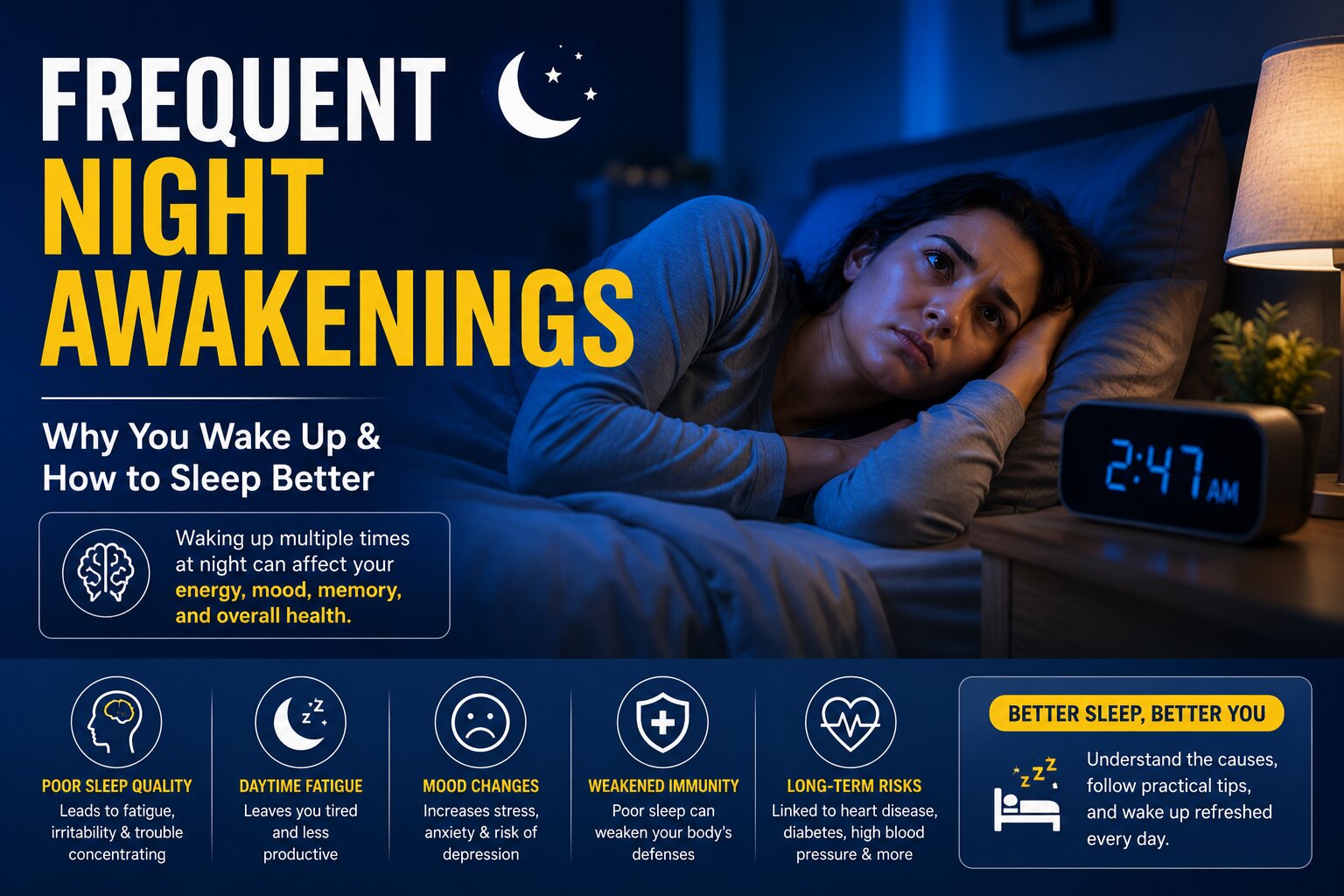
Waking up multiple times a night is not a normal part of healthy sleep for most adults, and it usually has an identifiable cause. Sleep apnea is one of the most common drivers, producing repeated brief arousals through the night that the person may experience as frequent waking without realising breathing is involved. But other causes, needing the bathroom, restless legs, anxiety, hormonal changes, and pain also produce fragmented sleep, and the right approach depends on which one is actually responsible.
What Normal Night Waking Looks Like
Sleep naturally moves through cycles. Light sleep, deep sleep, and REM sleep alternate through the night, with brief moments of lighter sleep or partial waking between cycles. Most adults have one or two of these natural light-sleep transitions per night. Brief enough that they don't remember them in the morning.
When waking becomes frequent three, four, five times or more or when the person is fully awake for extended periods and struggles to return to sleep, something has shifted. Either the sleep cycle is being interrupted by an external or internal trigger, or the brain is becoming too active during what should be lighter sleep transitions, pulling the person into full wakefulness.
That distinction matters because it shapes where the investigation starts.
Sleep Apnea: A Cause Many People Don't Connect to Night Waking
Many patients don't associate their frequent waking with breathing. They assume they're a light sleeper, or that they've always been this way, or that they need the bathroom more as they've gotten older.
But sleep apnea produces exactly this pattern. Each time an apnea event occurs the airway closes, breathing stops, oxygen drops the brain triggers a partial arousal to restore breathing. Sometimes this is enough to fully wake the person. They shift position, perhaps visit the bathroom, and fall back asleep. Then it happens again an hour later.
The person rarely connects these awakenings to breathing because they have no memory of the apnea event itself. They just know they keep waking up.
Two signs are particularly suggestive of sleep apnea as the cause of night waking. First, the person also feels tired during the day despite what feels like a reasonable amount of time in bed. Second, a partner has noticed snoring or pauses in breathing. When those two things are present alongside frequent waking, a sleep assessment is warranted.
A home sleep test records what's happening to breathing through the night. It's straightforward, done at home, and gives a clear answer about whether sleep apnea is present and how significant it is.
Nocturia: Waking to Use the Bathroom
Needing the bathroom once during the night is common and generally not a sign of anything significant. Waking two or more times most nights is called nocturia, and it deserves investigation.
The obvious assumption is a bladder or prostate problem. And sometimes that's the cause. But sleep apnea is a less obvious and frequently missed driver of nocturia.
Why does sleep apnea cause frequent urination at night? During apnea events, the body's arousal response triggers hormonal changes. The heart produces more of a hormone called atrial natriuretic peptide in response to the pressure changes that occur during attempted breathing against a closed airway. This hormone signals the kidneys to produce more urine. The result is a full bladder, even without drinking more fluids than usual.
This connection is seen regularly in sleep medicine practice. Patients who have been told their nocturia is prostate or bladder related and haven't improved with urology treatment sometimes find the problem resolves when sleep apnea is treated. Not always. But often enough that it's worth checking.
If nocturia is present alongside tiredness, snoring, or morning headaches, a sleep assessment should run alongside any urological investigation, not after it.
Anxiety and the Hyperalert Brain
Anxiety produces a state of heightened physiological arousal that's incompatible with deep, sustained sleep. The brain remains more active than it should be. Light sleep transitions become full awakenings. The person lies awake, often with racing thoughts, unable to return to sleep easily.
This pattern is often worse in the early hours particularly the two to four in the morning window that many anxious sleepers describe. The reasons relate to natural hormonal shifts overnight, with cortisol levels beginning to rise in the early hours as the body prepares for the day. In people with anxiety, this physiological shift can tip a light-sleep transition into a prolonged waking episode.
Anxiety-related night waking isn't always accompanied by obvious daytime anxiety. Some people feel generally fine during the day but find their mind becomes active the moment they try to sleep, or in the early hours when they wake.
Where anxiety is a significant driver, cognitive behavioural therapy for insomnia is the recommended first-line approach. It addresses the thought patterns and sleep-related behaviours that maintain the waking cycle. Medication is an option in some situations but is not the first-line recommendation, particularly where sleep apnea hasn't been excluded.
Hormonal Causes: Menopause and Night Sweats
Hot flushes and night sweats are among the most common causes of frequent night waking in women around the time of menopause. The sudden temperature changes wake the person from sleep. Getting comfortable again takes time. Falling back asleep after a hot flush can be difficult, particularly if sleep has already been fragmented.
What's less well recognised is that menopause also significantly increases sleep apnea risk. Oestrogen and progesterone both appear to protect airway muscle tone. When these hormones decline, that protection reduces. Women who develop new or worsening sleep disturbance around menopause may have both hot flushes and sleep apnea contributing and treating one without investigating the other produces incomplete results.
Women in this situation often benefit from a sleep assessment to clarify whether sleep apnea is part of the picture. If it is, CPAP therapy may improve sleep quality significantly beyond what is achievable through menopause management alone.
Pain and Other Medical Causes
Chronic pain conditions can produce frequent waking throughout the night. Arthritis, back pain, fibromyalgia, and other musculoskeletal conditions cause discomfort that surfaces during sleep, particularly as the person shifts position.
Acid reflux reaching the throat during sleep can cause waking with a burning sensation or coughing. It can also trigger laryngospasm, a brief involuntary throat closure that produces an alarming waking episode before resolving.
Thyroid conditions, particularly an overactive thyroid, increase overall physiological arousal and can disrupt sleep significantly. Blood sugar fluctuations during the night, relevant in patients with diabetes, can also produce waking episodes.
A thorough clinical history covers all of these possibilities rather than defaulting to one explanation.
Key Takeaways
- Waking two or more times per night consistently is worth investigating. It has identifiable causes in most cases.
- Sleep apnea is a common and underrecognised driver of frequent night waking, including waking to use the bathroom. Many patients don't connect their night waking to breathing.
- Nocturia linked to sleep apnea often improves when sleep apnea is treated, not just when bladder or prostate issues are managed.
- Restless legs and periodic limb movement disorder produce sleep fragmentation that is identifiable through a sleep study.
- Anxiety-related waking, particularly in the early hours, is driven by hyperarousal and responds to cognitive behavioural therapy for insomnia.
- Menopause increases sleep apnea risk alongside hot flush-related waking. Both causes may need assessment.
Conclusion
Frequent night awakenings affect how the whole day feels. The tiredness accumulates. Focus suffers. Energy stays low. And the cause often goes unidentified because waking at night seems like something people just have to accept.
Most causes are identifiable. And most are treatable. The starting point is a proper assessment that looks at the full picture rather than assuming one explanation.
Dr. Syed Arshad Husain consults at Al Zahra Hospital, Dubai, with extensive experience in sleep medicine and respiratory conditions. If frequent night waking is affecting your sleep and daily life, a sleep assessment is the clearest next step.
To book a consultation, call +971 04 378 6666.