Short-Term vs Long-Term Sleep Deprivation: Two Different Problems
It helps to separate these, because they work differently and carry different levels of concern.
Short-term sleep deprivation: a few nights of poor sleep due to illness, stress, travel, or a newborn produces familiar symptoms. Poor concentration. Irritability. Physical tiredness. Reduced coordination. These effects are real, but they are largely reversible with recovery sleep. The body bounces back.
Chronic sleep deprivation consistently sleeping significantly less than your body needs over weeks, months, or years is a different matter. The effects accumulate at a cellular and systemic level. They do not simply reverse with one or two good nights. And crucially, the subjective sense of "feeling fine" becomes increasingly unreliable the longer chronic deprivation continues.
What Happens to the Brain First
The brain is the most immediately affected organ when sleep is insufficient, and the effects begin faster than most people expect.
After just one night of poor sleep, reaction time slows, working memory degrades, and the ability to regulate emotions weakens noticeably. Decision-making quality drops. The prefrontal cortex responsible for judgement, impulse control, and rational thinking is particularly sensitive to sleep loss.
After several consecutive nights of restricted sleep, cognitive performance continues to decline, but subjective sleepiness plateaus. People feel "about the same" while performing measurably worse. This disconnect is well-documented in sleep research and has real-world consequences in driving, in medical settings, in any situation requiring sustained concentration and sound judgement.
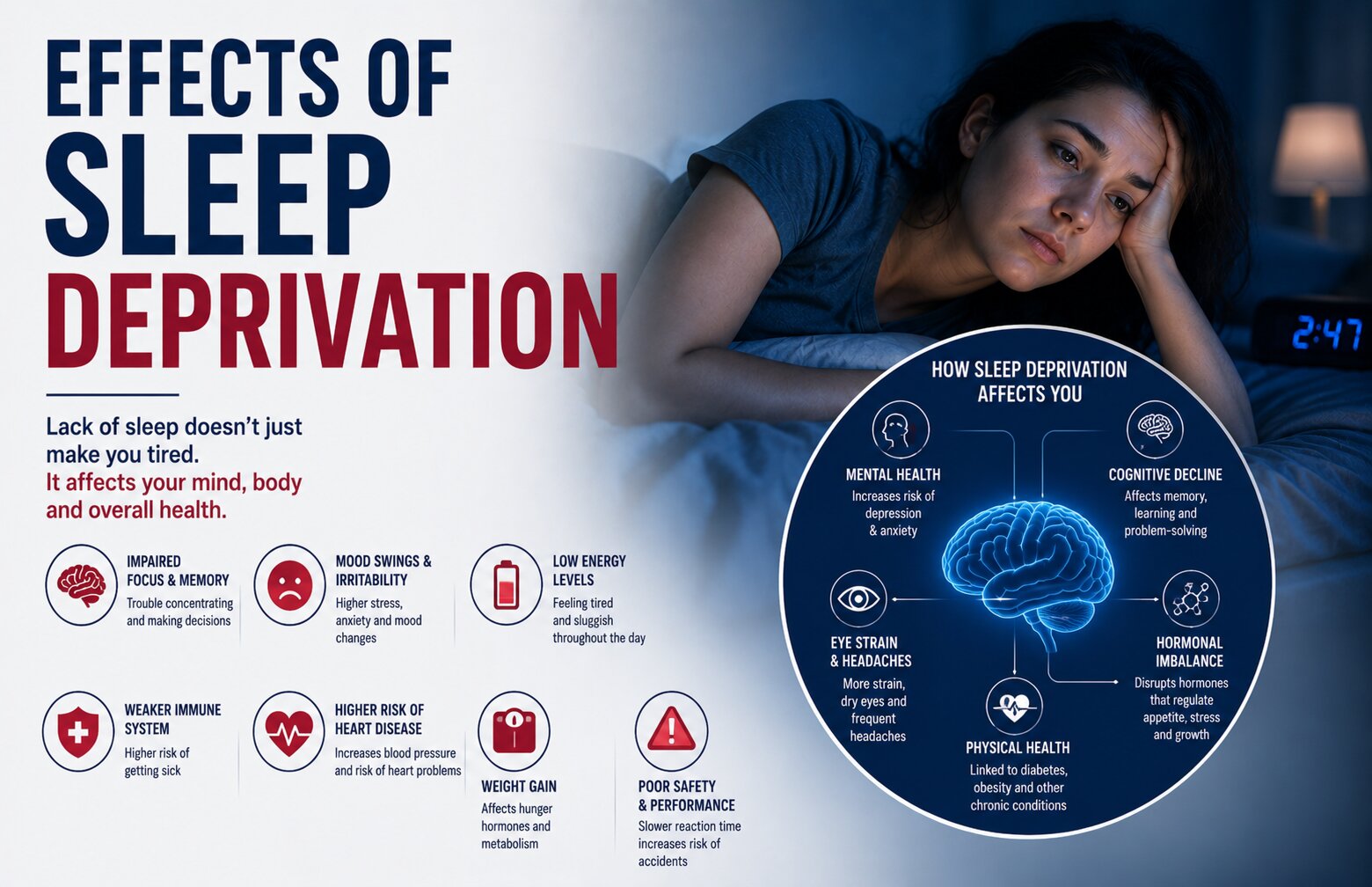
One specific phenomenon worth understanding is microsleep. These are brief, involuntary episodes of sleep lasting anywhere from a fraction of a second to several seconds that occur when the sleep-deprived brain essentially forces itself offline. The person has no awareness that it happened. Behind the wheel or operating machinery, a microsleep of even two or three seconds is enough to cause a serious accident. Research suggests that driving while significantly sleep-deprived impairs reaction time comparably to driving above the legal alcohol limit.
Over the longer term, chronic sleep loss is associated with accelerated cognitive decline and an increased risk of neurodegenerative disease. One of the reasons involves the glymphatic system, the brain's waste-clearance network, which operates primarily during deep sleep. When deep sleep is consistently reduced or fragmented, the clearance of toxic proteins including amyloid beta becomes less efficient. Amyloid accumulation is closely linked to Alzheimer's disease, which is why sleep researchers have been paying close attention to this mechanism in recent years.
What Happens to the Body
The Heart and Blood Vessels
Healthy sleep includes a nightly dip in blood pressure, a period of cardiovascular recovery that the heart depends on. Chronic sleep deprivation removes this dip. Blood pressure stays elevated for longer across the 24-hour cycle, arterial walls face more sustained stress, and inflammatory markers associated with cardiovascular disease rise.
Adults sleeping fewer than six hours consistently carry a significantly higher risk of hypertension, heart attack, and stroke than those sleeping seven to eight hours. This is not a correlation that requires much interpretation. The mechanism is clear enough: the heart is not getting its recovery window, and the consequences accumulate over time.
The Immune System
Sleep is when the immune system does a significant portion of its work producing cytokines, activating T cells, and strengthening antibody responses. Deprive the body of sufficient sleep and immune competence measurably falls.
Studies have shown that people sleeping six hours or fewer are considerably more susceptible to common viral infections than those sleeping seven or more. For patients already managing respiratory conditions asthma, COPD, or recovering from a chest infection this matters significantly. A respiratory illness that a healthy immune system resolves in a week can set a chronically sleep-deprived patient back by considerably longer.
Metabolism and Weight
Two hormones that regulate appetite ghrelin and leptin are directly disrupted by sleep deprivation. Ghrelin, which signals hunger, rises. Leptin, which signals fullness, falls. The result is a hormonal environment that promotes overeating and preference for calorie-dense foods even when the person is not physically more active or burning more energy than usual.
Insulin sensitivity also decreases with chronic sleep loss, raising the risk of type 2 diabetes over time. Weight gain driven by sleep deprivation in turn increases the risk of obstructive sleep apnea which then further degrades sleep quality. For many patients, breaking that cycle requires addressing the sleep disorder directly, not simply trying harder with diet and exercise.
The Lungs and Respiratory System
From a pulmonology standpoint, chronic sleep deprivation has specific implications. Sleep loss increases systemic inflammation, which directly worsens airway inflammation in patients with asthma and COPD. Respiratory muscle function also becomes less efficient with sustained sleep deprivation, affecting breathing mechanics.
For patients with obstructive sleep apnea where breathing stops repeatedly through the night the deprivation is not voluntary but structural. The airways collapse, oxygen drops, and the brain forces brief arousals to restore breathing. This can happen dozens or hundreds of times per night without the person being aware of waking. The result is profound sleep deprivation despite spending seven or eight hours in bed, which is why these patients often feel exhausted regardless of their apparent sleep duration.
Signs You May Be More Sleep Deprived Than You Realise
People who are chronically sleep-deprived often do not describe themselves as sleepy. They describe something subtler and more insidious.
Common signs include:
- Relying heavily on caffeine to feel functional during the day
- Falling asleep within minutes of sitting quietly or travelling
- Difficulty retaining information or following conversations
- Mood that is consistently lower, flatter, or more reactive than it used to be
- Getting ill more frequently than you would expect
- Waking unrefreshed regardless of what time you went to bed
- Being told you snore, gasp, or stop breathing during sleep
That last point is important. If someone has observed pauses in your breathing during sleep, that is not a minor symptom. It is a clinical signal that warrants investigation.
When Sleep Deprivation Has a Medical Cause
Not all sleep deprivation is behavioural. Many patients are genuinely trying to sleep and being prevented from doing so by an underlying condition most commonly obstructive sleep apnea, but also restless legs syndrome, insomnia driven by anxiety, or other sleep disorders.
These patients often feel a degree of shame about their fatigue, as though they should be able to solve it with better habits or earlier bedtimes. The reality is that no amount of sleep hygiene will compensate for an airway that collapses forty times per hour. Diagnosis and treatment of the underlying disorder is what changes outcomes for these patients.
A sleep study or home sleep test can identify exactly what is happening during the night including how often breathing is disrupted, how much oxygen is dropping, and how severely sleep architecture is being fragmented.
Key Takeaways
- Short-term sleep deprivation is largely reversible; chronic sleep deprivation accumulates and causes lasting systemic harm
- Cognitive impairment from sleep loss begins after a single night and worsens without the person accurately perceiving it
- Microsleep involuntary brief sleep episodes is a direct safety risk in drivers and anyone operating machinery
- Chronic sleep deprivation raises cardiovascular risk, impairs immune function, disrupts metabolism, and worsens respiratory conditions
- The glymphatic system clears brain waste primarily during sleep; chronic deprivation is linked to increased neurodegenerative risk
- Many patients are sleep deprived not from poor habits but from an undiagnosed sleep disorder particularly obstructive sleep apnea
- Waking unrefreshed despite adequate hours in bed is a clinical signal, not a lifestyle issue