Addressing sleep problems in children begins with establishing a baseline for healthy pediatric sleep architecture. Healthy sleep involves continuous, uninterrupted transitions through multiple stages of non-REM and REM sleep. When this architecture is disrupted, the child experiences severely fragmented rest. Medical sleep problems are characterized by chronic difficulty initiating sleep, frequent and prolonged nighttime awakenings, and abnormal respiratory events during unconsciousness.
Unlike adults, children do not typically present with complaints of daytime fatigue or lethargy. Instead, pediatric sleep deprivation manifests almost entirely as neurobehavioral dysfunction. Clinicians look for paradoxical symptoms, including extreme daytime hyperactivity, severe mood lability, aggressive outbursts, and a marked inability to sustain attention in academic environments. Furthermore, sleep problems in children often present with physical markers such as delayed growth curves. The disruption of deep, slow-wave sleep directly inhibits the normal secretion of human growth hormone from the pituitary gland. Identifying these disturbances requires caregivers to closely monitor not only the total duration of sleep but the actual physical quality of the child's respiration and movement throughout the entire night.
Evaluating Child Sleep Apnea Symptoms
However, the most serious etiology of sleep disturbance in children is pediatric sleep apnea (Obstructive Sleep Apnea or OSA), which is characterized by repeated episodes of complete or partial upper airway obstruction during sleep resulting in hypoxemia and hypercapnia.
Parents need to know how to detect signs of child sleep apnea. Witnessed apneas (complete cessation of breath for several seconds), which are followed by sudden and loud gasps, snorts, or jerks of the body due to the arousal of the autonomic nervous system to restart respiration, are the hallmark of the clinical presentation of the disease. The restlessness of the night sleep and constant tossing in bed as the child tries to find the appropriate sleeping position in order to clear his airway is characteristic for children with OSA. Another feature of OSA is unusual sleeping positions of the children including sitting upright, sleeping on numerous pillows, or hyperextension of the neck.
Among other symptoms of secondary sleep apnea in children are excessive night-time sweating, especially around the neck and head. The reason for such excessive sweating is that the body works very hard to move air through the obstruction. Furthermore, such children tend to suffer from secondary enuresis, meaning that they wet their beds, even though they are already potty trained. It happens because of the hormonal changes during an apnea event.
The Pathology of Snoring in Children and Airway Obstruction
A pervasive and dangerous myth in general pediatrics is that heavy snoring is a benign or normal condition. Medically, chronic snoring in children is the acoustic byproduct of turbulent airflow and a primary indicator of an underlying airway obstruction. In a healthy pediatric respiratory system, inhalation and exhalation are completely silent. Snoring occurs exclusively when the pharyngeal airway is narrowed, forcing air to accelerate and causing the surrounding soft tissues to vibrate loudly.
The leading anatomical cause of this airway obstruction in the pediatric demographic is adenotonsillar hypertrophy—the abnormal enlargement of the tonsils and adenoids. These lymphatic tissues are situated at the critical junction of the nasal cavity and the throat. When a child falls asleep, the surrounding muscle tone naturally relaxes. If the tonsils and adenoids are disproportionately large, this muscle relaxation allows the heavy tissues to collapse inward, physically pinching the windpipe shut.
When snoring in children is accompanied by increased respiratory effort—such as retractions, where the skin between the ribs or at the base of the neck pulls inward forcefully with every breath—it constitutes a clear medical emergency. This physical obstruction strains the cardiovascular system, elevating pulmonary blood pressure and forcing the right ventricle of the heart to work exponentially harder to pump blood through the lungs to compensate for the lack of oxygen.
Addressing the Root Cause: Why Is My Child Not Sleeping?
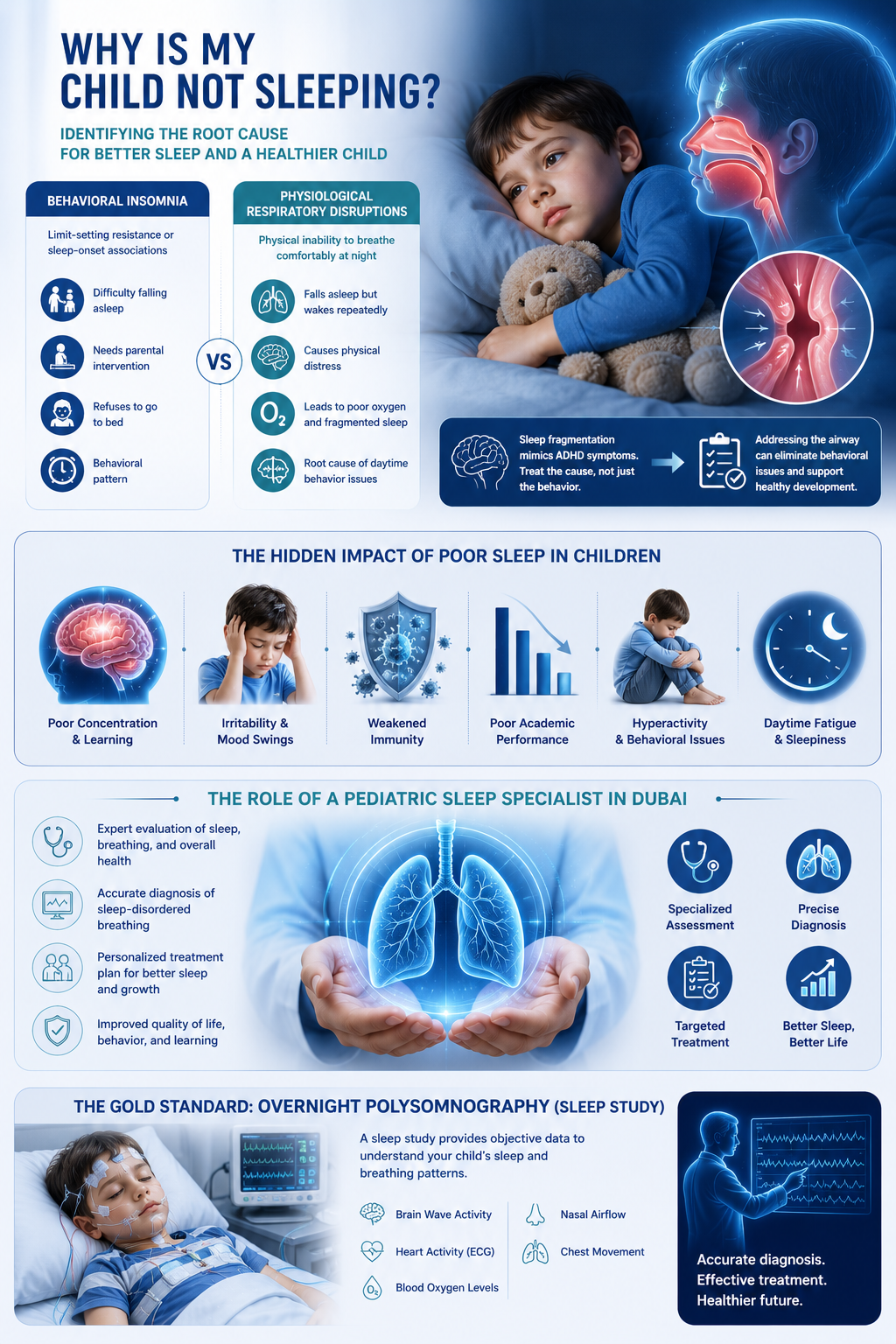
In pediatric visits, the most common concern that emerges from parents is the following: "why is my child not sleeping?" In order to find out the correct reason, physicians have to precisely differentiate between behavioral insomnia of childhood and physiological respiratory disturbances. Behavioral insomnia involves the refusal to go to sleep or limit-setting issues in terms of falling asleep initially.
Yet, if the child falls asleep easily enough but frequently awakes with some physical stressors, the behavioral approach will be of no use. "Why is my child not sleeping" becomes not a problem of behavioral psychology but of respiratory physiology. There is an enormous clinical overlap of sleep fragmentation syndrome with Attention Deficit Hyperactivity Disorder (ADHD). In view of the fact that the child's brain reacts to lack of sleep with hyperarousal, many kids are misdiagnosed with a behavioral disorder, although the underlying issue is physical inability to breathe while sleeping. The solution of physiological obstruction leads to the cure of sleep disturbance syndrome, and thus behavioral problems disappear completely without any stimulants.
The Role of a Pediatric Sleep Specialist in Dubai
Treatment of such a disorder in children encountered by Dubai population calls for specific intervention on the part of a healthcare professional. While general pediatricians can detect certain symptoms, the proper diagnosis and treatment of sleep disordered breathing need a special pediatric sleep specialist or pulmonary doctor.
An overnight polysomnogram (sleep study) is the method most commonly used for diagnosing sleep disorders. During this diagnostic procedure, which is not invasive, there is performed a monitoring of brain waves, heart rate, blood oxygen level, nasal air flow and chest movement. Sleep specialist uses this objective information to assess the degree of the problem and find the spot where the obstruction happens.