We can address the primary question without delay. You compare CPAP and BiPAP? Both of them are extremely powerful forms of non-invasive ventilation equipment. Both of them are placed right by your bedside table. Both of them have a flexible tube. Both of them are connected to a mask that covers either your nose or your mouth. In addition, both of them pursue precisely the same purpose – making sure that your airways remain open throughout the night in order for your brain to receive oxygen that is so much needed by it.
However, the critical difference between those two lies in the way of delivering the air pressure.
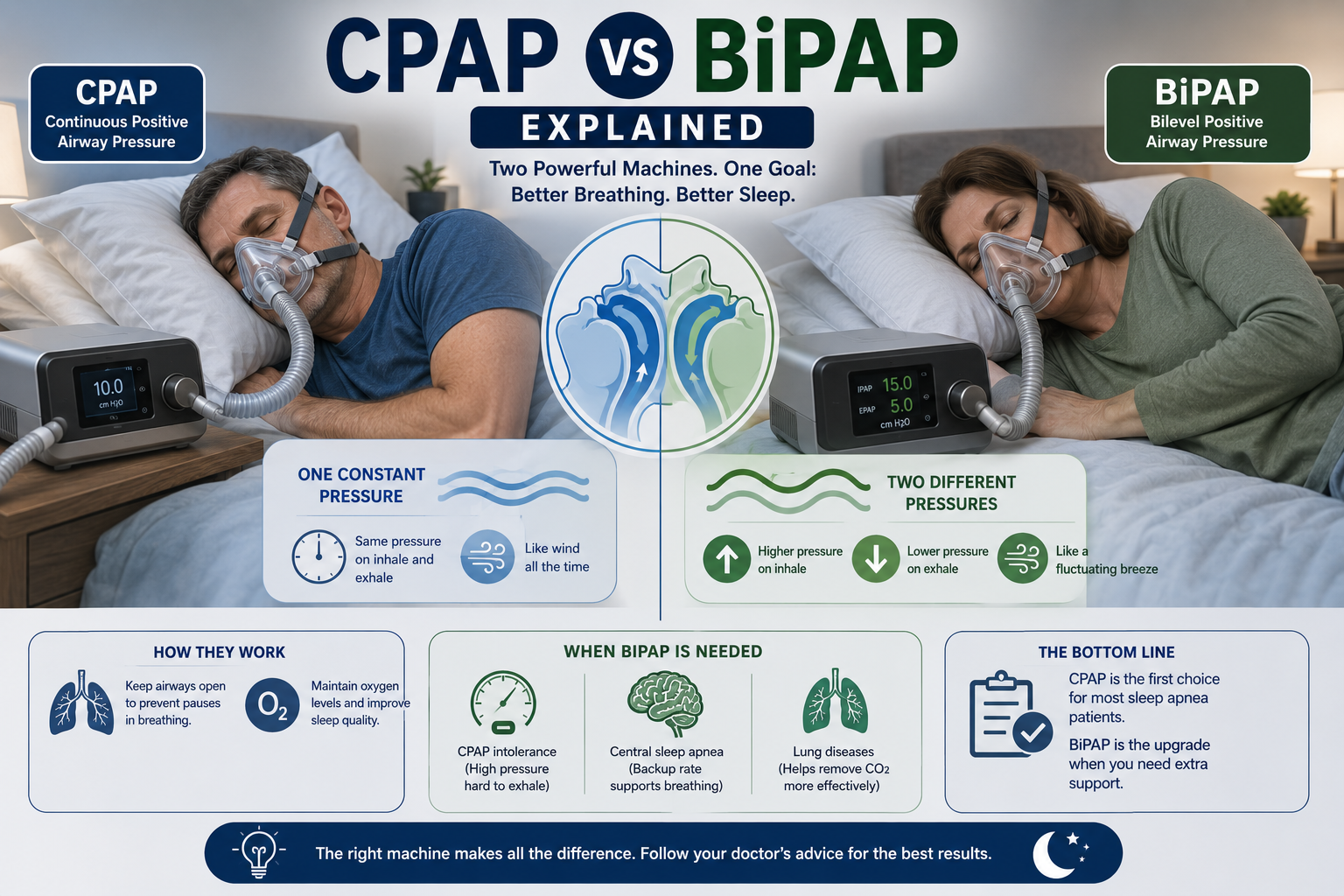
CPAP gives you just one consistent flow of air throughout the whole duration of the machine’s work. BiPAP gives you two different streams of air – high air pressure while inhaling, and low pressure while exhaling. The main difference lies there. One is like wind all the time; the other is like fluctuating breeze.
The CPAP vs BiPAP Debate
Comparing CPAP and BiPAP requires an understanding through the use of the driving analogy.
Think of setting your cruise control to a speed of 60 miles per hour. It does not matter if you are driving uphill or driving downhill because your car will use equal effort to maintain that speed. This is how CPAP works. The device provides constant air splint in order to ensure that your airways remain open.
Think now of the smart transmission system where the system pushes hard when driving uphill and reduces the pressure when going downhill so that you do not feel the need to press on the gas pedal. This is how BiPAP works. The system provides the air pressure to facilitate breathing and ensures that the airway remains open. But as soon as it detects an attempt at exhaling, the pressure reduces allowing the patient to expel the carbon dioxide from his lungs without exerting effort against the machine.
For many patients, breathing against the continuous pressure of CPAP feels just like breathing out of the car window while the vehicle is still in motion. It can be incredibly uncomfortable, and that discomfort is exactly where BiPAP steps in to save the day.
Exploring the Specifics
To get a better grip on which device does what, we need to look at the specific scenarios where one outshines the other.
The Core Difference Between CPAP and BiPAP
The difference between CPAP and BiPAP lies in the pressure settings used. CPAP is short for Continuous Positive Airway Pressure. The machine uses one pressure setting. With a prescription of 10 centimeters of water (cm H2O), you have 10 cm H2O on inhalation, as well as 10 cm H2O on exhalation.
BiPAP is short for Bilevel Positive Airway Pressure. It has two pressure settings: Inspiratory Positive Airway Pressure (IPAP) and Expiratory Positive Airway Pressure (EPAP). Your doctor may program the IPAP to be 15, which opens the airway but sets your EPAP at 5 to facilitate easy breathing out.
BiPAP vs CPAP Machine: The Hardware
When placed together on a table, the comparison between a BiPAP and a CPAP device will make you confused about which is which. The physical appearance of both devices is almost the same. Both of them have the same size as that of a wall clock or a shoebox. Both of them employ the same masks, the same headgear, and the same filters. The main difference lies in the internal working of both of these devices. The motor and the control board in a BiPAP machine are very complicated as they constantly monitor your breathing to change pressure every time your breathing cycle changes.
When is BiPAP Needed?
This is the million-dollar question. When is BiPAP needed? If CPAP is the standard, why bother with the upgrade?
Doctors usually step a patient up to a BiPAP machine for a few specific reasons:
- CPAP Intolerance: The patient has severe sleep apnea that requires a very high CPAP pressure (like 15 or 20 cm H2O). Trying to exhale against pressure that high is exhausting. Patients end up ripping the mask off in the middle of the night because they feel like they are suffocating. BiPAP lowers that exhalation pressure, making it tolerable.
- Central Sleep Apnea: Unlike standard obstructive sleep apnea (where the throat collapses), central sleep apnea is a neurological issue where the brain simply forgets to tell the lungs to breathe. BiPAP machines can be equipped with a backup respiratory rate. If the machine senses you haven't taken a breath in 10 seconds, it will force a breath into your lungs. A standard CPAP cannot do this.
- Complex Lung Diseases: Patients with overlapping conditions like COPD (Chronic Obstructive Pulmonary Disease) or restrictive lung diseases struggle to expel carbon dioxide. A BiPAP helps physically flush that toxic gas out of the lungs.
CPAP or BiPAP for Sleep Apnea?
So, is it worth it for you to get CPAP/BiPAP from your doctor if you have sleep apnea? Ninety percent of the time, CPAP is the first line of defense. It is the gold standard treatment for regular obstructive sleep apnea. Insurance companies will never even think about covering a BiPAP unless you have tried CPAP first and failed. You begin with CPAP, and if that doesn’t work for you, or if you’re still not getting enough oxygen at night, you’ll move to the bilevel treatment.
The Science of Airway Management
In any case, both of these medical devices represent amazing inventions that can help to cure people of serious breathing problems.
If a person has a problem with obstructive sleep apnea, the muscles of his/her throat become excessively relaxed while he/she is sleeping deeply. As a result, airways close, and oxygen does not get into the lungs. Brain reacts to it and releases high amounts of adrenaline, causing waking up in order to make a gasp of air. This process can repeat 30, 40, or 100 times per hour. In the morning, a person feels tired, his/her blood pressure increases dramatically, and his/her heart is under huge pressure.
Using CPAP means creating a pneumatic splint in order to keep the muscles of the throat wide open. However, understanding the exact amount of pressure or the necessity to switch to a BPAP machine is only possible if you have a lot of medical knowledge.
These medical devices cannot be bought and used without the advice of a specialist. In case you are seeking for the best pulmonologist in Dubai, Prof. Dr. Syed Arshad Husain will be a perfect choice.
As a practitioner at Al Zahra Hospital Dubai, Dr. Husain has more than 30 years’ experience with the United Kingdom’s National Health Service (NHS).
A specialist such as Dr. Husain does not simply hand you a box. They take into account the overall picture. They perform sleep tests overnight in order to determine precisely when and how your airway is closing. They check for co-morbid conditions such as asthma, cough, or COPD. In case you have trouble with your CPAP machine, a specialist with the experience of Dr. Husain will analyze your machine’s data card, your leakage rates, and your inability to exhale, and smoothly move you to the BiPAP mode, which will let you enjoy the eight hours of uninterrupted sleep. Treating these disorders properly means adding years to your life.