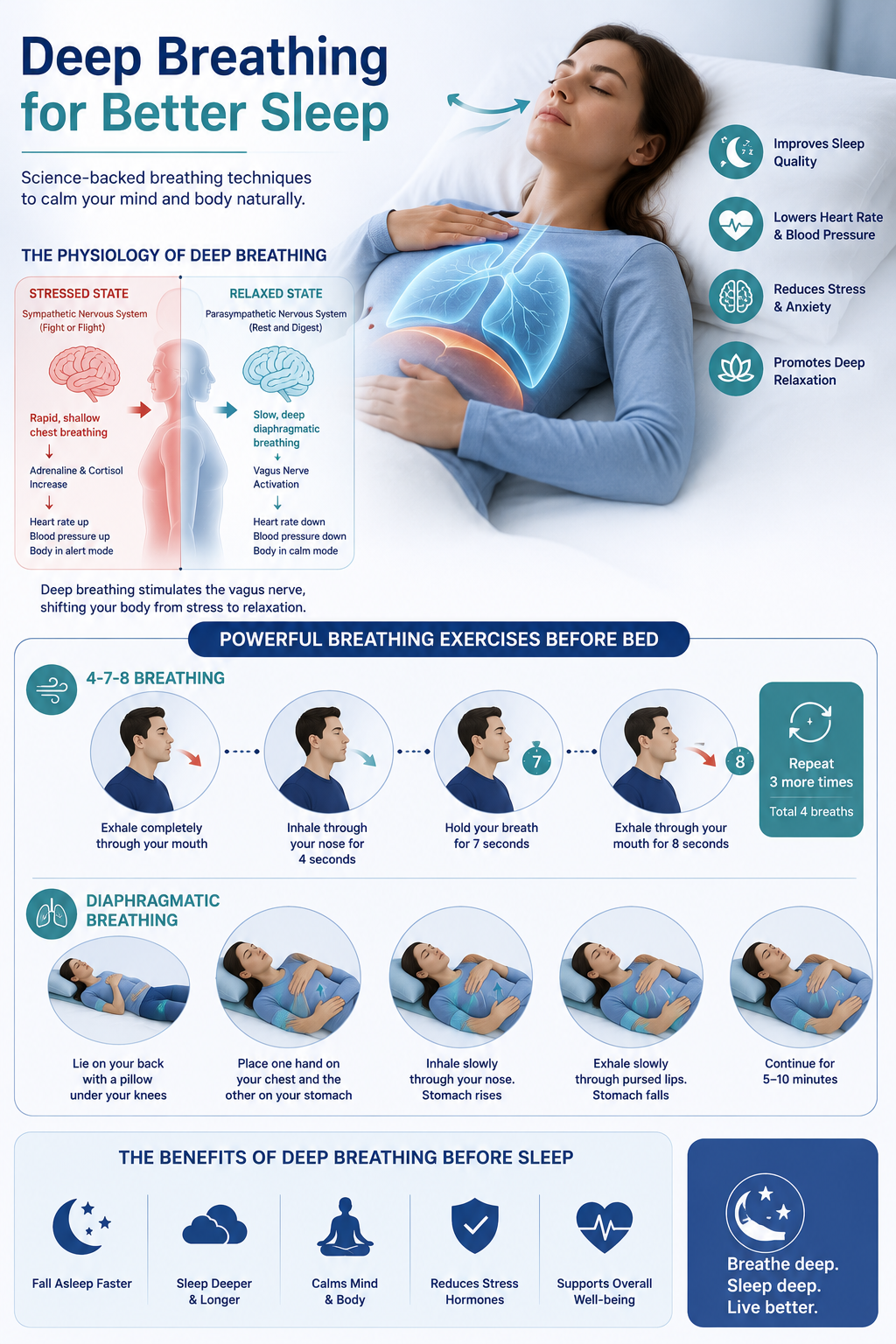
For one to realize how controlled breathing works, it is essential to study the body's autonomic nervous system, which comprises of two major components; the sympathetic nervous system, responsible for "fight or flight," and the parasympathetic nervous system responsible for "rest and digest."
In cases where one is stressed, anxious, and experiencing insomnia, the sympathetic nervous system becomes extremely active. In such a state, breathing is deep, rapid, and occurs in the upper part of the chest. This kind of breathing sends a signal to the brain that there is a real threat hence causing a continued production of adrenaline and cortisol.
The deep breathing process for sleep directly involves the vagus nerve which is an integral part of the parasympathetic nervous system. With the conscious act of slow and deep breathing involving the use of the diaphragm, the vagus nerve is stimulated, leading to the production of a chain reaction resulting in the slowing of the heartbeat and a decrease in blood pressure and stress hormone production. Application of the relaxation technique in such a way will force the body to relax biologically.
Core Breathing Exercises to Sleep Better
Implementing structured breathing routines before bed can drastically reduce the time it takes to fall asleep. Here are highly effective breathing exercises to sleep better that you can utilize immediately.
1. The 4-7-8 Breathing Technique
The 4-7-8 method is based on ancient yogic practices and is highly regarded as a natural tranquilizer for the nervous system.
- Part your lips slightly and make a whooshing sound as you exhale completely through your mouth.
- Close your lips and inhale silently through your nose for a mental count of four seconds.
- Hold your breath for a count of seven seconds.
- Exhale completely through your mouth, making a whooshing sound, for a count of eight seconds.
- This completes one breath. Repeat the cycle three more times for a total of four breaths.
2. Diaphragmatic Breathing (Belly Breathing)
Many people unknowingly default to shallow chest breathing. Diaphragmatic breathing focuses on fully engaging the diaphragm, the large muscle at the base of the lungs, to maximize oxygen exchange and trigger deep relaxation.
- Lie flat on your back in bed with a pillow under your knees to support your lower back.
- Place one hand on your upper chest and the other resting on your stomach, just below your rib cage.
- Breathe in slowly through your nose. The hand on your stomach should rise, while the hand on your chest should remain relatively still.
- Exhale slowly through pursed lips (as if blowing through a straw). The hand on your stomach should fall back to its original position.
- Continue this rhythmic breathing for five to ten minutes, focusing entirely on the rise and fall of your abdomen.
3. Box Breathing (Square Breathing)
This technique is utilized by athletes and military personnel to regulate the nervous system under extreme stress. It is equally effective for quieting a hyperactive mind before sleep.
- Inhale slowly and deeply through your nose for a count of four.
- Hold the air in your lungs for a count of four.
- Exhale slowly and smoothly through your mouth for a count of four.
- Hold your lungs empty for a count of four before inhaling again.
- Repeat this "box" cycle for several minutes until you feel your physical tension dissipate.
Targeted Breathing Techniques for Insomnia
Insomnia is frequently driven by hyperarousal and anxiety. When you cannot sleep, you often begin to stress about the fact that you are not sleeping, which further activates the sympathetic nervous system. Breathing techniques for insomnia act as a cognitive anchor.
When utilizing the 4-7-8 or Box Breathing methods, the brain is forced to concentrate on the counting and the physical sensation of air moving in and out of the body. This continuous focus disrupts the loop of anxious, racing thoughts. By occupying the mind's processing power with a structured, rhythmic task, you prevent it from ruminating on daily stressors, thereby breaking the cycle that sustains insomnia.
Exercises for Sleep Apnea and Respiratory Disorders
While relaxation breathing helps you fall asleep, patients with respiratory disorders like obstructive sleep apnea (OSA) face a different physiological challenge: airway collapse during sleep. It is vital to understand that breathing exercises alone cannot cure structural sleep apnea. However, specific orofacial myofunctional therapies (throat and tongue exercises) combined with proper breathing mechanics can significantly improve daytime breathing efficiency and support clinical treatments.
Exercises for sleep apnea focus on strengthening the muscles of the airway and promoting nasal breathing.
- Tongue Slides: Place the tip of your tongue against the roof of your mouth, just behind your front teeth, and slide it backward. Repeat this 20 times. This strengthens the tongue and prevents it from falling back into the throat during sleep.
- Nasal Breathing Practice: During the day, practice keeping your mouth closed and breathing exclusively through your nose. Nasal breathing increases nitric oxide production, which helps widen blood vessels and improve oxygen saturation.