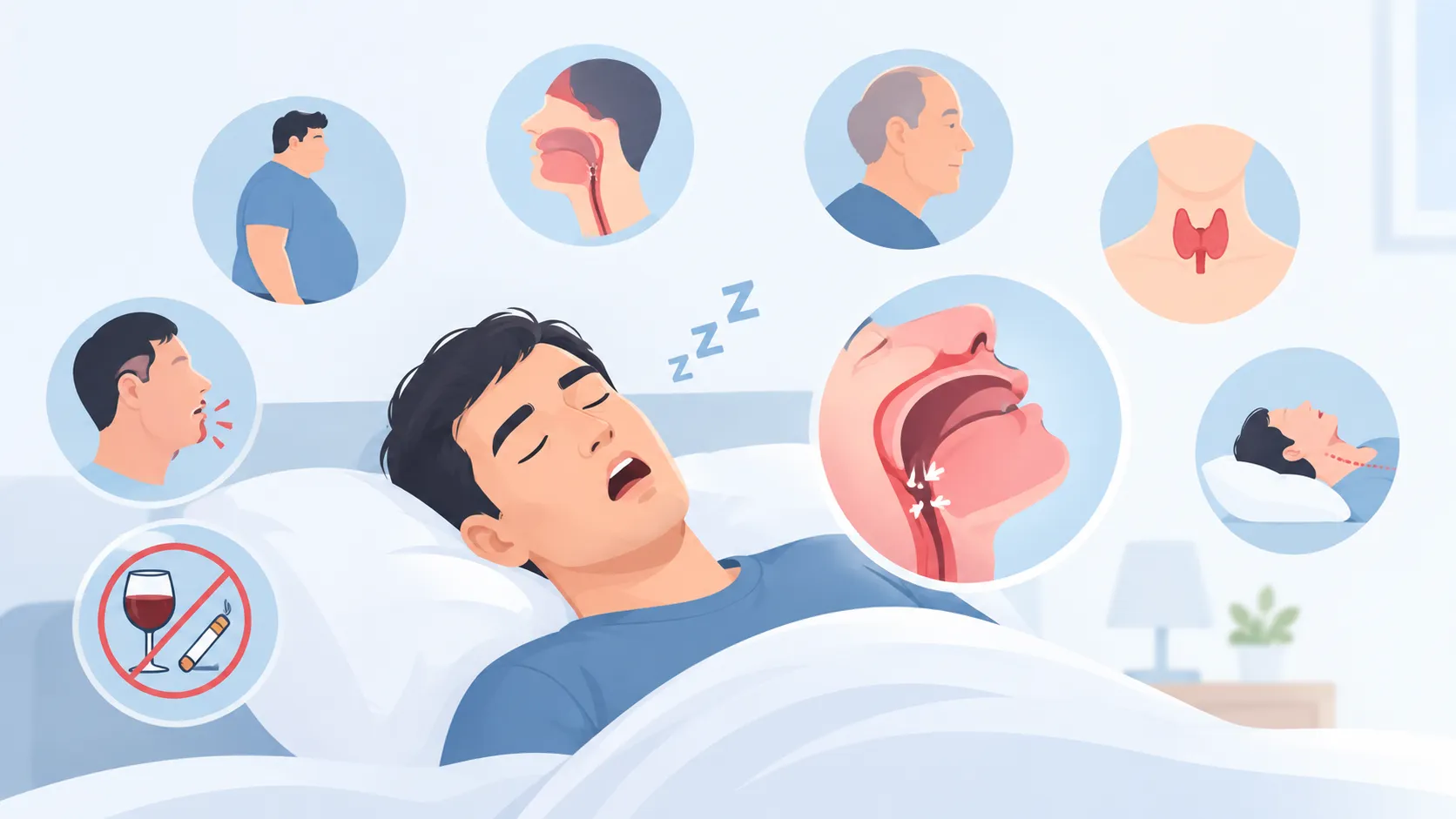
Snoring is the symptom people notice. The cause sits deeper — in an airway that narrows and closes when the muscles holding it open relax during sleep.
What causes obstructive sleep apnea in adults? Obstructive sleep apnea is caused by repeated collapse or narrowing of the upper airway during sleep, which blocks airflow despite continued breathing effort. Contributing factors include excess weight, upper airway anatomy, nasal obstruction, sleep position, and reduced muscle tone in the throat during sleep.
Why You Can Trust This Guide
Written by a consultant pulmonologist and based on the American Heart Association's 2021 scientific statement and American Academy of Sleep Medicine guidance. Risk factors described here are associations reported in that literature; they explain who is more likely to have OSA, not who definitely does.
The mechanism, plainly
During sleep, the muscles that keep the throat open relax. In a susceptible airway, that relaxation is enough for the walls to narrow or meet. Breathing effort continues — the chest still moves — but airflow stops or drops. Oxygen falls, the brain briefly arouses, tone returns, the airway opens. Then it repeats.
These recurrent complete and partial obstructive events produce intermittent hypoxemia, autonomic fluctuation and sleep fragmentation. That is why the tiredness is so disproportionate to hours in bed: the hours are there, the sleep is not.
Who it affects
Approximately 34% of middle-aged men and 17% of middle-aged women meet the diagnostic criteria for OSA, and prevalence varies by race and ethnicity, sex, and obesity status. Sleep disturbances are common and underdiagnosed among middle-aged and older adults.
Contributing factors
| Factor | Why it matters |
|---|---|
| Excess weight | Soft tissue around the airway and reduced lung volumes make collapse more likely |
| Airway anatomy | Enlarged tonsils, a crowded oropharynx or jaw structure narrow the airway |
| Nasal obstruction | Forces mouth breathing and increases negative pressure in the airway |
| Sleep position | Supine sleep allows the tongue and soft palate to fall backwards |
| Age | Airway muscle tone declines |
| Sex | Higher reported prevalence in men at middle age |
| Alcohol and sedating substances | Further relax airway muscles |
Warning signs worth acting on
- Loud habitual snoring, particularly with witnessed pauses
- Waking gasping or choking
- Unrefreshing sleep and daytime sleepiness despite adequate time in bed
- Morning headache, dry mouth
- Difficulty concentrating, irritability
- Nocturia
- High blood pressure, especially if difficult to control
Does snoring mean you have sleep apnea? No. Snoring is caused by vibration of relaxed upper airway tissue and can occur without sleep apnea. Obstructive sleep apnea involves actual airflow obstruction with oxygen drops and sleep fragmentation. Distinguishing the two requires a sleep study measuring the apnea-hypopnea index, not an assessment of snoring volume.
How it is confirmed
Testing is done by overnight in-laboratory polysomnography or home sleep apnea testing, and diagnosis requires an apnea-hypopnea index or respiratory event index of 5 or more alongside reported symptoms. Wearables and apps may flag a pattern worth investigating. They do not diagnose.
Seek medical care promptly if
- Someone has witnessed you stop breathing in your sleep
- You have fallen asleep driving or come close to it
- You wake with chest pain or shortness of breath
- Your blood pressure is difficult to control despite treatment
Takeaways
- OSA is airway collapse during sleep, not simply heavy snoring
- Weight, anatomy, nasal obstruction, position, age and sedating substances all contribute
- Reported prevalence is roughly 34% of middle-aged men and 17% of middle-aged women
- Snoring alone does not confirm OSA; a sleep study does
- Daytime sleepiness with witnessed pauses is the combination to act on
Concerned about your sleep? Book a consultation with Prof. Dr. Syed Arshad Husain at Al Zahra Hospital Dubai - +971 54 384 4156.